.png)


Advancing Agritech Innovations Through Academic Research: An Integrative Review of Global University Partnerships
Author: Liam Johnson
Affiliation: Swiss International University (SIU)
ORCID ID: 0009-0005-3168-1739
Submitted 17 April 2026; Revised 13 June 2026; Accepted 21 July 2026; Available online 08 August 2026; Version of Record 08 August 2026.
Doi: https://doi.org/10.65326/u7y.SpecSDG10006
Volume 3, December 2026, (SpecSDG10006)

Abstract
Agritech innovation increasingly depends on partnerships that connect universities with firms, governments, advisory services, and farming communities, yet scholarship on these partnerships is split between two literatures that rarely engage each other. Research on university–industry collaboration offers mature accounts of engagement channels, barriers, and governance, but it synthesizes evidence across sectors and seldom treats agriculture as a distinct institutional setting. Social science on digital agriculture and agricultural innovation systems examines farms, advisory networks, and food system transitions, but it does not theorize the organizational forms through which universities enter these systems. This article reports an integrative review that connects the two bodies of work. Drawing on peer-reviewed studies published mainly between 2016 and 2026, identified through structured searches of Scopus, Web of Science, and Google Scholar and screened against explicit inclusion criteria, the review pursues three questions: which partnership configurations link universities to agritech innovation, through which mechanisms those configurations translate academic research into innovation outcomes, and under which contextual conditions the mechanisms operate in high-income and in low- and middle-income settings. The synthesis produces a typology of five partnership configurations and a conceptual framework that links configurations, translation mechanisms, contextual conditions, and the directionality of innovation. The central argument is that partnership form must match the knowledge mechanism it is intended to carry, and that context and responsibility considerations condition every pathway from academic research to agritech outcomes. Implications for university leaders, policymakers, and comparative research are set out.
Keywords: agritech innovation, university–industry collaboration, technology transfer, digital agriculture, agricultural innovation systems, integrative review
1. Introduction
Agricultural technology has become one of the most active frontiers of innovation policy. Digital sensing, data analytics, automation, and precision management promise gains in productivity and sustainability at the same time (Basso & Antle, 2020; Wolfert et al., 2017), and perspective pieces in the food systems literature argue that a broad portfolio of such innovations can accelerate the transition towards sustainable food systems (Herrero et al., 2020). The promise, however, is unevenly realized. Lowenberg-DeBoer and Erickson (2019) found that satellite-based guidance and associated automation spread as quickly as any major agricultural technology in history, while adoption of variable-rate applications, which demand more knowledge-intensive integration, rarely exceeded twenty percent of farms. In low- and middle-income countries, reviews of digital advisory services report substantial potential alongside persistent difficulties of scale and financing (Aker, 2011; Deichmann et al., 2016; Fabregas et al., 2019). The pattern that emerges from this evidence is not a shortage of technology but a shortage of arrangements that connect research to heterogeneous users under real institutional conditions.
Universities sit at the center of this connection problem. They conduct much of the basic and applied research on which agritech draws, they train the agronomists, engineers, and data scientists who staff the sector, and they are increasingly expected to contribute directly to innovation as part of a third mission that extends beyond teaching and research (Compagnucci & Spigarelli, 2020). How universities organize that contribution is the subject of a large scholarship on university–industry collaboration, which has mapped engagement channels (D'Este & Patel, 2007), distinguished relational engagement from commercialization (Perkmann et al., 2013), synthesized organizational forms and process factors (Ankrah & Al-Tabbaa, 2015), and tracked the field's growth through bibliometric and systematic reviews (Mascarenhas et al., 2018; Perkmann et al., 2021; Skute et al., 2019).
The difficulty is that these two research conversations have developed with little reference to each other, and the space between them is precisely where agritech partnerships operate. The university–industry collaboration literature is deliberately cross-sectoral: its major reviews synthesize evidence spanning many industries and do not treat agriculture as a distinct analytic category with its own user structures, advisory institutions, and public-good characteristics (Ankrah & Al-Tabbaa, 2015; Perkmann et al., 2013, 2021; Skute et al., 2019). The agricultural literature, for its part, has developed sophisticated accounts of innovation systems, digitalization, and advisory networks (Fielke et al., 2020; Ingram & Maye, 2020; Klerkx et al., 2019; World Bank, 2012), but in these accounts universities typically appear as one actor among many; the partnership configurations through which they engage, and the mechanisms those configurations carry, are not themselves theorized. The consequence, and the gap this review addresses, is that neither literature can currently answer a question that matters to university leaders designing agritech programmes, to ministries and funders deciding which partnership instruments to support, and to researchers seeking cumulative knowledge: which forms of university partnership advance agritech innovation, through which mechanisms, and under which conditions.
This article answers that question through an integrative review with a conceptual contribution. Following the methodological tradition of Torraco (2005) and Whittemore and Knafl (2005), it reads the two literatures against each other and synthesizes them into a typology and a framework. Three research questions structure the review:
RQ1. Through which partnership configurations do universities engage with industry, government, advisory services, and farming communities in agritech innovation?
RQ2. Through which mechanisms do these configurations translate academic research into agritech innovation outcomes?
RQ3. Under which contextual conditions do these mechanisms operate, and how do those conditions differ between high-income and low- and middle-income settings?
The contribution is threefold. First, the review consolidates dispersed evidence into a typology of five partnership configurations observable in agritech (Table 1). Second, it proposes a conceptual framework, presented in Figure 1, that links configurations to innovation outcomes through identifiable translation mechanisms, moderated by contextual conditions and steered by considerations of directionality and responsibility. Third, it derives from this framework a research agenda for comparative work on university partnerships in agriculture. The remainder of the article proceeds as follows: the next section reviews the two parent literatures thematically; the Method section sets out the review protocol; the Findings section develops the typology, mechanisms, and conditions; the Discussion draws theoretical and policy implications, states the review's limitations, and assesses how far the gap has been closed; the Conclusion summarizes the argument.
2. Literature Review
University engagement and the organization of collaboration
The theoretical starting point for most work on university partnerships is the Triple Helix model, which describes innovation as the product of interdependent relations among universities, industry, and government rather than of any single institutional sphere (Etzkowitz & Leydesdorff, 2000). Carayannis and Campbell (2009) extended this reasoning with a Quadruple Helix that adds a fourth strand, the media-based and culture-based public, and with the claim that multiple modes of knowledge production coexist and co-evolve rather than replacing one another. Both ideas matter for agriculture, where public legitimacy and cultural attitudes toward food and technology shape what innovations are acceptable, a point to which the review returns.
Within this broad frame, a distinct literature examines how collaboration is actually organized. Perkmann et al. (2013) drew an influential distinction between academic engagement, meaning collaborative research, contract research, and consulting sustained through relationships, and commercialization, meaning patenting, licensing, and venture creation; their follow-up review of work published between 2011 and 2019 documents how strongly research on engagement has grown as a field in its own right (Perkmann et al., 2021). D'Este and Patel (2007) showed for the United Kingdom that academics interact with industry through a much wider variety of channels than patenting statistics capture. Ankrah and Al-Tabbaa (2015) systematized the organizational forms, motivations, and process dynamics of collaboration, and Mascarenhas et al. (2018) and Skute et al. (2019) mapped the field's growth and its main research streams. Collectively these reviews establish that partnership form is consequential: different forms carry different kinds of knowledge and impose different governance demands.
A second stream examines why collaboration succeeds or fails. Bruneel et al. (2010) showed that barriers between academic and industrial partners are not fixed features of the relationship but can be attenuated, drawing attention to relational assets such as trust. Rajalo and Vadi (2017) reconceptualized collaboration at the level of individual partnerships, arguing that productive interaction depends on conditions internal to each dyad rather than on formal agreements alone. The review by de Wit-de Vries et al. (2019) synthesized the mechanisms of knowledge transfer in university–industry research partnerships, underscoring that transfer is an accomplishment of process rather than an automatic by-product of contact. At a more aggregate level, Galan-Muros and Davey (2019) assembled an ecosystem framework for university–business cooperation, and Heaton et al. (2019) applied dynamic capabilities theory to argue that a university's capacity to sense opportunities, seize them, and reconfigure its own structures shapes its contribution to an innovation ecosystem; they add that the flexible, entrepreneurial university management this requires has received less scholarly attention than the Triple Helix model it presupposes. Compagnucci and Spigarelli (2020) documented both the potential and the constraints of the third mission, including tensions with universities' core teaching and research tasks.
Agricultural innovation systems and the digital turn
Agricultural scholarship approaches innovation from the opposite direction: not from the university outward but from the farming system inward. The agricultural innovation systems perspective, codified for investment practice by the World Bank (2012), treats innovation as the emergent outcome of interactions among research organizations, education, extension and advisory services, firms, and farmers, and directs attention to the institutions that link them. Pigford et al. (2018) pushed this perspective toward an innovation ecosystems approach oriented to niche design in sustainability transitions, and Klerkx and Begemann (2020) reframed it in mission-oriented terms, asking what directional missions for food systems imply for who participates in innovation and how.
Digitalization has given this literature a strong contemporary focus. Wolfert et al. (2017) reviewed big data applications in smart farming; Klerkx et al. (2019) organized the emerging social science on digital agriculture, smart farming, and Agriculture 4.0 and set out a future research agenda for the field; Fielke et al. (2020) reviewed how digitalization reshapes agricultural knowledge and advice networks; and Ingram and Maye (2020) examined what digitalization means for agricultural knowledge itself, including the position of formal expertise. Basso and Antle (2020) argued that digital tools should be used to design sustainable agricultural systems rather than merely to optimize existing ones, a formulation that presupposes sustained interaction between researchers and practitioners rather than one-way technology delivery. In lower-income settings, Aker (2011) reviewed evidence on information and communication technologies as channels for agricultural extension, Deichmann et al. (2016) proposed a framework in which digital technology contributes through inclusion, efficiency, and lower transaction costs while cautioning that it removes only some of the barriers smallholders face, and Fabregas et al. (2019) reviewed digital agricultural advice and identified the financing of such services as an unresolved problem.
Two further strands complete the picture. A responsibility strand argues that Agriculture 4.0 requires broader and earlier societal engagement than conventional technology assessment provides: Rose and Chilvers (2018) called for widening responsible innovation in smart farming, Eastwood et al. (2019) traced how responsible research and innovation can move from fragmented practices to a comprehensive approach in technology development programmes, and Klerkx and Rose (2020) argued that transition pathways should preserve diversity rather than lock in a single technological trajectory. A bundling strand holds that technological innovations transform food systems only when combined with social and institutional innovations (Barrett et al., 2020; Herrero et al., 2020).
The unresolved intersection
Read together, the two literatures leave a specific question open. The collaboration literature explains partnership forms and mechanisms but abstracts from agriculture's institutional particularities: dispersed and heterogeneous adopters, a central role for advisory intermediaries, strong public-interest stakes, and, in much of the world, smallholder production under infrastructure constraints. The agricultural literature explains those particularities but does not differentiate among the university partnership forms operating within them. This is an interpretive assessment of the corpus reviewed here rather than a finding of any single study, and it defines the task of this review: to specify the partnership configurations, mechanisms, and conditions jointly, so that findings from each literature can discipline the other.
3. Method
Review design and rationale
The review follows the integrative method, which combines diverse designs and literatures in order to generate new frameworks rather than to estimate effects (Torraco, 2005; Whittemore & Knafl, 2005). An integrative design was chosen over a systematic-review design for two reasons. First, the relevant evidence is heterogeneous: it spans conceptual work in innovation studies, reviews and empirical studies in agricultural economics, and social science on digitalization, which no single effect-size logic could aggregate. Second, the review's purpose is theory construction, the purpose for which Snyder (2019) recommends integrative over systematic approaches. The design implements the stages that Whittemore and Knafl (2005) specify: problem identification, literature search, data evaluation, data analysis, and presentation.
Search strategy
Searches were conducted in Scopus and Web of Science, complemented by Google Scholar for coverage of institutional reports and forward and backward citation tracking. Search strings combined a university-partnership block with an agritech block. Representative strings were: ("university–industry" OR "academic engagement" OR "technology transfer" OR "university partnership" OR "third mission") AND (agritech OR "agricultural technology" OR "digital agriculture" OR "smart farming" OR "precision agriculture" OR "agricultural innovation"); and ("agricultural innovation system" OR "innovation ecosystem" OR "advisory services" OR extension) AND (university OR "higher education" OR research). The core publication window was 2016 to 2026, reflecting the period in which digital agriculture scholarship consolidated; seminal earlier works were retained where the conceptual argument required them, including foundational statements of the Triple Helix and integrative-review methodology. Searches were limited to English-language publications.
Inclusion and exclusion criteria and screening
Sources were included if they satisfied all of the following: (a) peer-reviewed journal article, or institutional publication from an international organization with documented review processes; (b) substantive treatment of at least one of the review's three constructs, namely university or research-organization partnerships, knowledge translation mechanisms, or agricultural innovation conditions; (c) conceptual, review, or empirical design with transparent method. Sources were excluded if they (a) addressed agricultural technology with no institutional or organizational content, such as purely agronomic or engineering studies; (b) addressed university collaboration only in teaching contexts without a research or innovation dimension; or (c) could not be verified against bibliographic records. Screening proceeded in two stages, title-and-abstract followed by full-record assessment, applying the criteria in the order listed. Because the search was iterative and citation tracking was used throughout, the review does not report a quantitative screening flow; the corpus is instead documented through full citation of every included source, each verified against its bibliographic record before inclusion.
Analysis and framework derivation
Data evaluation followed the integrative-review convention of appraising sources for relevance and methodological transparency rather than through a single quality-scoring instrument, since the corpus deliberately mixes conceptual, review, and empirical designs whose quality criteria differ (Whittemore & Knafl, 2005). Each source's bibliographic record was checked against its publisher or index entry, and the type of claim each source could support, conceptual proposition, single-study finding, or synthesized evidence, was recorded at the point of coding so that attribution strength in the synthesis would match the underlying evidence.
Included sources were then coded into a concept matrix organized by the three research questions: the partnership forms a source described or theorized, the mechanisms it identified as carrying knowledge between partners, and the conditions it associated with success, failure, or exclusion. Constant comparison across the two parent literatures was then used to consolidate forms into configurations, to align mechanism vocabularies (for example, matching the collaboration literature's account of relational engagement with the agricultural literature's account of knowledge intermediation), and to distinguish moderating conditions from steering considerations. The typology in Table 1 is the direct output of the first coding dimension; the framework in Figure 1 integrates all three. Both are conceptual syntheses: they organize claims made in the cited literature and do not report new empirical estimates.
Rigor and trustworthiness
Three practices bounded bias. First, every reference was verified against its bibliographic record before citation, and claims are attributed at the strength the underlying source supports, with single-study findings reported as such. Second, the two parent literatures were searched and coded symmetrically, so that the framework is not an extension of one literature with the other as decoration. Third, the review's scope boundaries are explicit: it covers English-language scholarship, it prioritizes the 2016 to 2026 window, and its unit of analysis is the partnership configuration, not the individual technology or the individual scientist. Within these boundaries the protocol above is reproducible: another reviewer applying the same strings, window, and criteria would assemble a corpus with substantially the same composition, though the interpretive synthesis would remain a judgment for which the authorial reading is accountable.
4. Findings
A typology of university partnership configurations in agritech (RQ1)
The corpus yields five recurrent configurations through which universities engage in agritech innovation, summarized in Table 1. They differ in principal actors, in the mechanism that carries knowledge, and in the kind of outcome they are organized to produce.
The first configuration is bilateral academic engagement: collaborative research, contract research, and consulting between university groups and agritech firms or producer organizations. This is the agricultural instance of the engagement channel that Perkmann et al. (2013, 2021) identify as the dominant mode of university–industry interaction generally, and the variety of its concrete channels mirrors the variety D'Este and Patel (2007) documented across sectors. The second configuration is commercialization: patenting, licensing, and spin-off formation around university-held technology, the channel that the same literature distinguishes sharply from engagement (Perkmann et al., 2013) and that third-mission scholarship shows to be demanding of specialized university structures (Compagnucci & Spigarelli, 2020). The third configuration is the mission-oriented consortium: multi-partner programmes in which government, universities, and industry align around a defined objective such as emissions reduction or food security, the form that mission-oriented agricultural innovation systems thinking anticipates (Klerkx & Begemann, 2020) and that inherits its logic from the Triple Helix (Etzkowitz & Leydesdorff, 2000). The fourth configuration is the ecosystem platform: a university acting as durable anchor of a regional innovation ecosystem that includes incubation, capability building, and orchestration of many partners, consistent with the ecosystem frameworks of Galan-Muros and Davey (2019) and the dynamic-capabilities account of Heaton et al. (2019), and with the niche-design role that Pigford et al. (2018) sketch for agricultural sustainability transitions. The fifth configuration is the digital extension partnership: universities working with advisory services, digital platform providers, and farmer organizations to deliver and adapt knowledge-intensive services, the form foregrounded by scholarship on advisory-network digitalization (Fielke et al., 2020; Ingram & Maye, 2020) and by the developing-country evidence on ICT-mediated extension (Aker, 2011; Fabregas et al., 2019).
Three observations follow from the typology. First, the configurations are analytic rather than mutually exclusive: a single university may operate all five at once, and ecosystem platforms in particular often contain the other four as constituent activities. Second, the configurations are ordered by the breadth of the actor coalition they require, from the dyad of bilateral engagement to the multi-actor coalitions of platforms and extension partnerships; this ordering matters because the agricultural literature associates system-level outcomes with broader coalitions (Klerkx & Begemann, 2020; World Bank, 2012), while the collaboration literature shows that relational quality is easiest to sustain in narrow ones (Rajalo & Vadi, 2017). Partnership design in agritech therefore confronts a standing tension between relational depth and systemic reach. Third, the fifth configuration has no clear counterpart in the general university–industry literature; it is specific to sectors with strong advisory intermediation, which is one reason cross-sectoral reviews underdescribe agriculture. Its growing weight in the corpus reflects the digitalization of advice documented by Fielke et al. (2020), which repositions universities from suppliers of content for human advisers toward partners in the design and validation of digital advisory services themselves.
Table 1
Typology of University Partnership Configurations in Agritech Innovation
Configuration | Principal actors | Dominant translation mechanism | Typical outcome orientation | Illustrative sources |
Bilateral academic engagement | University research group; agritech firm or producer organization | Relational knowledge co-production | Firm- or organization-level product and process innovation | Perkmann et al. (2013); D'Este and Patel (2007); de Wit-de Vries et al. (2019) |
Commercialization | University technology transfer function; ventures and investors | Property-based transfer (patents, licences, spin-offs) | New agritech products and ventures | Perkmann et al. (2013); Compagnucci and Spigarelli (2020) |
Mission-oriented consortium | Government, universities, industry, and research funders | Agenda alignment and pooled research capacity | Directional, system-level innovation objectives | Klerkx and Begemann (2020); Etzkowitz and Leydesdorff (2000); World Bank (2012) |
Ecosystem platform | University as anchor with regional firms, incubators, and intermediaries | Capability building and ecosystem orchestration | Regional agritech ecosystem development | Heaton et al. (2019); Galan-Muros and Davey (2019); Pigford et al. (2018) |
Digital extension partnership | University, advisory services, platform providers, and farmer organizations | Co-design and digital knowledge intermediation | Farm-level adoption and inclusive advisory reach | Fielke et al. (2020); Ingram and Maye (2020); Aker (2011); Fabregas et al. (2019) |
Note. The typology is an analytic synthesis of the sources cited in each row; configurations co-occur in practice, and a single university may operate several simultaneously. Mechanism and outcome labels follow the framework developed in the Findings section.
Mechanisms that translate research into innovation (RQ2)
Across configurations, four translation mechanisms recur. The first is relational knowledge co-production. Reviews of knowledge transfer and academic engagement place sustained interpersonal relationships at the center of how knowledge moves between universities and firms (de Wit-de Vries et al., 2019; Perkmann et al., 2013); Bruneel et al. (2010) linked the attenuation of barriers between the academic and commercial spheres to relational factors such as trust; and Rajalo and Vadi (2017) located the conditions for productive interaction inside the individual partnership rather than in formal agreements. Agricultural evidence points the same way: advisory relationships remain central even as their medium digitalizes (Fielke et al., 2020; Ingram & Maye, 2020).
The second mechanism is property-based transfer: the codification of research into intellectual property that firms or ventures can carry to market. It is the mechanism proper to the commercialization configuration, and the literature warns against equating it with university impact in general, since it captures a narrow slice of interaction (D'Este & Patel, 2007; Perkmann et al., 2013).
The third mechanism is capability building. Ecosystem-level frameworks converge on the point that partnerships produce not only artifacts but capacities: absorptive capacity in firms, entrepreneurial capability in regions, and adaptive capability in universities themselves (Galan-Muros & Davey, 2019; Heaton et al., 2019). In agriculture this extends to farmer capability, which conditions whether knowledge-intensive technologies are usable at all; the contrast Lowenberg-DeBoer and Erickson (2019) draw between rapidly adopted automation, which embeds knowledge in the machine, and slowly adopted variable-rate management, which demands knowledge in the user, illustrates how outcomes depend on where capability resides.
The fourth mechanism is co-design: the joint specification of technologies and services with their eventual users. The responsibility literature treats co-design as the practical core of responsible innovation in smart farming (Eastwood et al., 2019; Rose & Chilvers, 2018), and Fabregas et al. (2019) point to locally relevant advice as central to the promise of digital extension. Interpreted through the framework developed here, co-design is the mechanism by which the fifth configuration compensates for the distance between laboratory and field that the other mechanisms leave open.
The alignment of mechanism with configuration is the review's central analytical claim: each configuration is, in effect, an institutional casing for one dominant mechanism, and partnership designs fail when the casing and the mechanism are mismatched, as when a co-design problem is handled through property-based transfer.
Contextual conditions across settings (RQ3)
The mechanisms do not operate uniformly. Four conditions recur in the corpus as moderators. The first is institutional distance within the partnership: differences in incentives, time horizons, and disclosure norms between academic and commercial partners, which the collaboration literature identifies as the root of persistent barriers (Bruneel et al., 2010; Rajalo & Vadi, 2017). The second is the strength of intermediary institutions. Where advisory systems are dense, universities can reach dispersed users through them; where digitalization reconfigures advisory networks, the position of formal research knowledge itself shifts (Fielke et al., 2020; Ingram & Maye, 2020). The third is infrastructure and user heterogeneity. Digital technologies presuppose connectivity, complementary inputs, and minimum scale; Deichmann et al. (2016) caution that they remove only some of the barriers facing poorer farmers, and Fabregas et al. (2019) identify the financing of digital advisory services as unresolved, both of which explain why pilot successes scale unevenly in low- and middle-income countries. The fourth is public legitimacy. The Quadruple Helix argument that innovation systems answer to a media- and culture-based public (Carayannis & Campbell, 2009) has particular force in food and agriculture, where societal acceptance conditions technology pathways, a point the responsible-innovation strand develops in detail (Klerkx & Rose, 2020; Rose & Chilvers, 2018). Data governance illustrates the interaction of these conditions: reviews of smart farming identify questions of data ownership and control among the issues that accompany big data applications (Wolfert et al., 2017), and such questions simultaneously raise institutional distance within partnerships, burden intermediaries who must broker data relationships, and put legitimacy at stake with farming communities. Conditions of this kind are therefore best read as a configuration of pressures rather than as a checklist of separate obstacles.
The high-income and low- and middle-income contrast, on this reading, is not a difference in kind but a difference in which conditions bind. In high-income settings the binding constraints cluster around institutional distance and legitimacy; in low- and middle-income settings they cluster around intermediary strength, infrastructure, and financing, with the agricultural innovation systems tradition supplying the investment logic for relaxing them (World Bank, 2012).
Directionality and responsibility as steering considerations
A final theme cuts across the other three. Recent agricultural scholarship insists that the question is not only whether partnerships produce innovation but which innovation they produce. Mission-oriented framings ask partnerships to serve defined societal objectives (Klerkx & Begemann, 2020); transition scholarship warns against locking food systems into a single technological pathway (Klerkx & Rose, 2020); and the bundling argument holds that technological innovations change food systems only when combined with social and institutional innovations (Barrett et al., 2020; Herrero et al., 2020). For university partnerships, directionality is therefore not an external policy constraint but a design parameter: it determines which configurations are appropriate, since missions favour consortia and platforms, and which mechanisms must be present, since responsibility requirements presuppose co-design (Eastwood et al., 2019).
Figure 1 integrates the four findings. Partnership configurations, on the left, translate academic research into agritech innovation outcomes, on the right, through the four mechanisms in the center. Contextual conditions moderate every configuration-mechanism-outcome pathway from below; directionality and responsibility steer the selection of configurations and mechanisms from above; and outcomes feed back into future partnership formation. The framework is conceptual: it organizes verified claims from the reviewed literature into a testable structure and makes no empirical estimate of pathway strength.
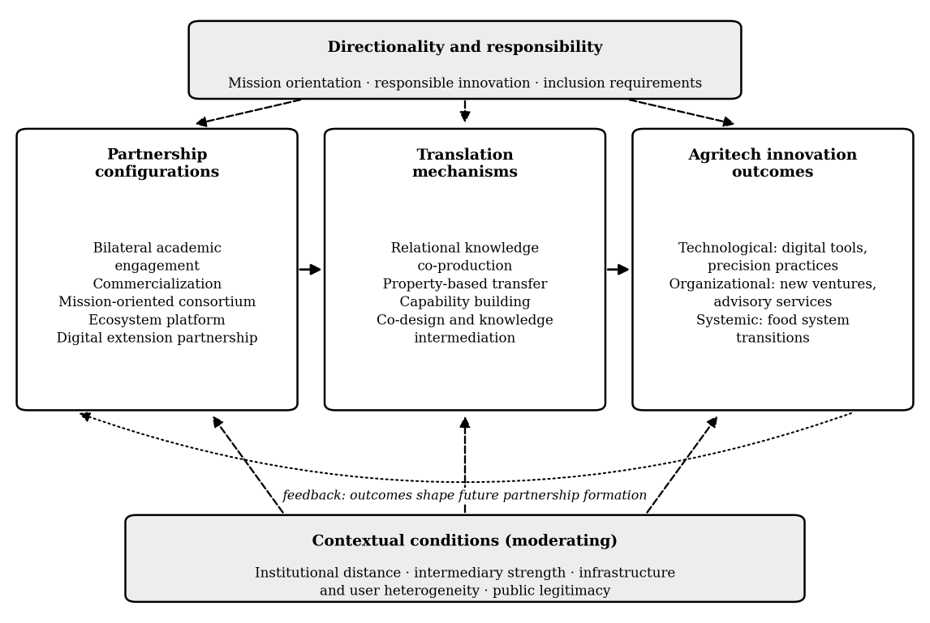
Figure 1. Conceptual framework linking university partnership configurations to agritech innovation outcomes. The framework is a conceptual synthesis of the reviewed literature; arrows denote proposed pathways, not estimated effects.
5. Discussion
Theoretical implications
The review carries three implications for theory. First, it shows that the university–industry collaboration literature's central distinction, engagement versus commercialization (Perkmann et al., 2013), is necessary but insufficient for agriculture: a sector with strong advisory intermediation requires at least the fifth configuration, digital extension partnership, and arguably treats it as the primary channel to the majority of users. Extending collaboration theory with sector-specific configurations is a more promising route than treating sector as a control variable. Second, the framework specifies where the two parent literatures connect: mechanisms are the join. The collaboration literature theorizes mechanisms with partnership-level precision but weak context; the agricultural literature theorizes context with system-level precision but undifferentiated partnerships; aligning both around mechanisms lets each discipline the other. Third, the analysis supports reading responsibility and directionality as design parameters of partnership rather than as external evaluation criteria, which connects responsible-innovation scholarship (Eastwood et al., 2019; Rose & Chilvers, 2018) to the organizational literature it has so far run parallel to.
Practical and policy implications
For university leaders, the typology functions as a portfolio instrument. Because engagement, not commercialization, is the channel the collaboration literature treats as primary (Perkmann et al., 2013, 2021), and because the adoption evidence associates diffusion of knowledge-intensive technologies with user capability (Lowenberg-DeBoer & Erickson, 2019), the synthesis implies that agritech strategies built mainly around patenting and spin-offs address a narrow part of the problem; portfolios should be weighted toward engagement, platform, and extension configurations, with commercialization reserved for technologies that genuinely travel as property. For policymakers and funders, the framework identifies the moderating conditions as the targets of public investment: intermediary institutions, connectivity, and service financing in low- and middle-income settings (Deichmann et al., 2016; Fabregas et al., 2019; World Bank, 2012), and boundary-spanning arrangements that reduce institutional distance in high-income settings (Bruneel et al., 2010). For both audiences, the directionality theme implies that partnership instruments should specify missions and inclusion requirements at the design stage rather than auditing them after the fact (Klerkx & Begemann, 2020). A further implication concerns measurement. Because the configurations carry different mechanisms, they require different indicators of success: licensing income is informative for the commercialization configuration but nearly meaningless for extension partnerships, whose contribution registers in advisory reach and user capability. Evaluation regimes that apply commercialization metrics across a whole portfolio will systematically undervalue the configurations that the agricultural evidence identifies as reaching most users, a measurement bias that third-mission scholarship has flagged in general terms (Compagnucci & Spigarelli, 2020) and that acquires particular weight in agriculture.
Limitations
The review's limitations follow from its method. It is an integrative synthesis, not a systematic review: it reports no quantitative screening flow, and corpus assembly involved iterative citation tracking in which authorial judgment shaped inclusion at the margin. Its evidence base is English-language and journal-weighted, which underrepresents grey literature from national innovation agencies and non-anglophone scholarship, both of which are likely to matter in agriculture. The framework is derived from literature that is itself uneven: the collaboration literature draws disproportionately on high-income economies, so the low- and middle-income cells of the synthesis rest on a thinner and more advisory-focused evidence base. Finally, the framework's pathways are conceptual propositions; the review provides no empirical test of their relative strength, and single-study findings cited in support, such as the adoption contrast reported by Lowenberg-DeBoer and Erickson (2019), should not be read as consensus estimates.
Future research
Three lines of work follow directly from what remains open. First, comparative empirical studies should test the typology's central claim, that configuration-mechanism fit predicts partnership outcomes, across sectors and income settings; the concept matrix underlying Table 1 offers a coding frame for such designs. Second, the fifth configuration needs dedicated study: research on how universities participate in digitalized advisory networks, and on sustainable financing models for digital extension, would address the open problem identified by Fabregas et al. (2019). Third, the responsibility strand would benefit from organizational specificity: studies of how mission requirements and inclusion criteria are written into partnership agreements, and with what effect, would connect responsible-innovation theory to partnership practice (Eastwood et al., 2019; Klerkx & Rose, 2020).
With respect to the gap stated in the Introduction, the review closes its conceptual portion: it specifies the configurations, mechanisms, and conditions that neither parent literature specified jointly, and it does so from verified published evidence. The empirical portion of the gap, measurement of pathway strength and comparative performance, remains open and defines the agenda above.
6. Conclusion
This article asked how university partnerships advance agritech innovation. An integrative review of the university–industry collaboration and agricultural innovation literatures produced a typology of five partnership configurations, bilateral engagement, commercialization, mission-oriented consortia, ecosystem platforms, and digital extension partnerships, and a conceptual framework in which these configurations translate academic research into innovation outcomes through four mechanisms: relational co-production, property-based transfer, capability building, and co-design. Contextual conditions, including institutional distance, intermediary strength, infrastructure, and public legitimacy, moderate the pathways, and directionality and responsibility considerations steer configuration choice. The central conclusion is that partnership form must match the knowledge mechanism it is meant to carry, and that in agriculture the match depends on conditions, especially advisory intermediation and user capability, that general collaboration theory does not model. Universities that treat their agritech engagement as a portfolio across configurations, and funders that invest in the conditions rather than only in the technologies, act in line with the synthesized evidence. The framework offered here is a structure for the comparative research that should now test it.
Declarations
Funding. This research received no external funding.
Conflicts of Interest. The author declares no conflict of interest.
Ethics. This study is a review of published literature and did not involve human participants, animal subjects, or personal data; ethical approval was therefore not required.
Data Availability. No new data were created or analyzed in this study. All sources synthesized are cited in the reference list and publicly available through the digital object identifiers provided.
References
Aker, J. C. (2011). Dial "A" for agriculture: A review of information and communication technologies for agricultural extension in developing countries. Agricultural Economics, 42(6), 631–647. https://doi.org/10.1111/j.1574-0862.2011.00545.x
Ankrah, S., & Al-Tabbaa, O. (2015). Universities–industry collaboration: A systematic review. Scandinavian Journal of Management, 31(3), 387–408. https://doi.org/10.1016/j.scaman.2015.02.003
Barrett, C. B., Benton, T. G., Cooper, K. A., Fanzo, J., Gandhi, R., Herrero, M., James, S., Kahn, M., Mason-D'Croz, D., Mathys, A., Nelson, R. J., Shen, J., Thornton, P., Bageant, E., Fan, S., Mude, A. G., Sibanda, L. M., & Wood, S. (2020). Bundling innovations to transform agri-food systems. Nature Sustainability, 3(12), 974–976. https://doi.org/10.1038/s41893-020-00661-8
Basso, B., & Antle, J. (2020). Digital agriculture to design sustainable agricultural systems. Nature Sustainability, 3(4), 254–256. https://doi.org/10.1038/s41893-020-0510-0
Bruneel, J., D'Este, P., & Salter, A. (2010). Investigating the factors that diminish the barriers to university–industry collaboration. Research Policy, 39(7), 858–868. https://doi.org/10.1016/j.respol.2010.03.006
Carayannis, E. G., & Campbell, D. F. J. (2009). 'Mode 3' and 'Quadruple Helix': Toward a 21st century fractal innovation ecosystem. International Journal of Technology Management, 46(3/4), 201–234. https://doi.org/10.1504/IJTM.2009.023374
Compagnucci, L., & Spigarelli, F. (2020). The Third Mission of the university: A systematic literature review on potentials and constraints. Technological Forecasting and Social Change, 161, Article 120284. https://doi.org/10.1016/j.techfore.2020.120284
Deichmann, U., Goyal, A., & Mishra, D. (2016). Will digital technologies transform agriculture in developing countries? Agricultural Economics, 47(S1), 21–33. https://doi.org/10.1111/agec.12300
D'Este, P., & Patel, P. (2007). University–industry linkages in the UK: What are the factors underlying the variety of interactions with industry? Research Policy, 36(9), 1295–1313. https://doi.org/10.1016/j.respol.2007.05.002
de Wit-de Vries, E., Dolfsma, W. A., van der Windt, H. J., & Gerkema, M. P. (2019). Knowledge transfer in university–industry research partnerships: A review. The Journal of Technology Transfer, 44(4), 1236–1255. https://doi.org/10.1007/s10961-018-9660-x
Eastwood, C., Klerkx, L., Ayre, M., & Dela Rue, B. (2019). Managing socio-ethical challenges in the development of smart farming: From a fragmented to a comprehensive approach for responsible research and innovation. Journal of Agricultural and Environmental Ethics, 32(5–6), 741–768. https://doi.org/10.1007/s10806-017-9704-5
Etzkowitz, H., & Leydesdorff, L. (2000). The dynamics of innovation: From National Systems and "Mode 2" to a Triple Helix of university–industry–government relations. Research Policy, 29(2), 109–123. https://doi.org/10.1016/S0048-7333(99)00055-4
Fabregas, R., Kremer, M., & Schilbach, F. (2019). Realizing the potential of digital development: The case of agricultural advice. Science, 366(6471), Article eaay3038. https://doi.org/10.1126/science.aay3038
Fielke, S., Taylor, B., & Jakku, E. (2020). Digitalisation of agricultural knowledge and advice networks: A state-of-the-art review. Agricultural Systems, 180, Article 102763. https://doi.org/10.1016/j.agsy.2019.102763
Galan-Muros, V., & Davey, T. (2019). The UBC ecosystem: Putting together a comprehensive framework for university–business cooperation. The Journal of Technology Transfer, 44(4), 1311–1346. https://doi.org/10.1007/s10961-017-9562-3
Heaton, S., Siegel, D. S., & Teece, D. J. (2019). Universities and innovation ecosystems: A dynamic capabilities perspective. Industrial and Corporate Change, 28(4), 921–939. https://doi.org/10.1093/icc/dtz038
Herrero, M., Thornton, P. K., Mason-D'Croz, D., Palmer, J., Benton, T. G., Bodirsky, B. L., Bogard, J. R., Hall, A., Lee, B., Nyborg, K., Pradhan, P., Bonnett, G. D., Bryan, B. A., Campbell, B. M., … West, P. C. (2020). Innovation can accelerate the transition towards a sustainable food system. Nature Food, 1(5), 266–272. https://doi.org/10.1038/s43016-020-0074-1
Ingram, J., & Maye, D. (2020). What are the implications of digitalisation for agricultural knowledge? Frontiers in Sustainable Food Systems, 4, Article 66. https://doi.org/10.3389/fsufs.2020.00066
Klerkx, L., & Begemann, S. (2020). Supporting food systems transformation: The what, why, who, where and how of mission-oriented agricultural innovation systems. Agricultural Systems, 184, Article 102901. https://doi.org/10.1016/j.agsy.2020.102901
Klerkx, L., Jakku, E., & Labarthe, P. (2019). A review of social science on digital agriculture, smart farming and agriculture 4.0: New contributions and a future research agenda. NJAS: Wageningen Journal of Life Sciences, 90–91, Article 100315. https://doi.org/10.1016/j.njas.2019.100315
Klerkx, L., & Rose, D. (2020). Dealing with the game-changing technologies of Agriculture 4.0: How do we manage diversity and responsibility in food system transition pathways? Global Food Security, 24, Article 100347. https://doi.org/10.1016/j.gfs.2019.100347
Lowenberg-DeBoer, J., & Erickson, B. (2019). Setting the record straight on precision agriculture adoption. Agronomy Journal, 111(4), 1552–1569. https://doi.org/10.2134/agronj2018.12.0779
Mascarenhas, C., Ferreira, J. J., & Marques, C. (2018). University–industry cooperation: A systematic literature review and research agenda. Science and Public Policy, 45(5), 708–718. https://doi.org/10.1093/scipol/scy003
Perkmann, M., Salandra, R., Tartari, V., McKelvey, M., & Hughes, A. (2021). Academic engagement: A review of the literature 2011–2019. Research Policy, 50(1), Article 104114. https://doi.org/10.1016/j.respol.2020.104114
Perkmann, M., Tartari, V., McKelvey, M., Autio, E., Broström, A., D'Este, P., Fini, R., Geuna, A., Grimaldi, R., Hughes, A., Krabel, S., Kitson, M., Llerena, P., Lissoni, F., Salter, A., & Sobrero, M. (2013). Academic engagement and commercialisation: A review of the literature on university–industry relations. Research Policy, 42(2), 423–442. https://doi.org/10.1016/j.respol.2012.09.007
Pigford, A.-A. E., Hickey, G. M., & Klerkx, L. (2018). Beyond agricultural innovation systems? Exploring an agricultural innovation ecosystems approach for niche design and development in sustainability transitions. Agricultural Systems, 164, 116–121. https://doi.org/10.1016/j.agsy.2018.04.007
Rajalo, S., & Vadi, M. (2017). University-industry innovation collaboration: Reconceptualization. Technovation, 62–63, 42–54. https://doi.org/10.1016/j.technovation.2017.04.003
Rose, D. C., & Chilvers, J. (2018). Agriculture 4.0: Broadening responsible innovation in an era of smart farming. Frontiers in Sustainable Food Systems, 2, Article 87. https://doi.org/10.3389/fsufs.2018.00087
Skute, I., Zalewska-Kurek, K., Hatak, I., & de Weerd-Nederhof, P. (2019). Mapping the field: A bibliometric analysis of the literature on university–industry collaborations. The Journal of Technology Transfer, 44(3), 916–947. https://doi.org/10.1007/s10961-017-9637-1
Snyder, H. (2019). Literature review as a research methodology: An overview and guidelines. Journal of Business Research, 104, 333–339. https://doi.org/10.1016/j.jbusres.2019.07.039
Torraco, R. J. (2005). Writing integrative literature reviews: Guidelines and examples. Human Resource Development Review, 4(3), 356–367. https://doi.org/10.1177/1534484305278283
Whittemore, R., & Knafl, K. (2005). The integrative review: Updated methodology. Journal of Advanced Nursing, 52(5), 546–553. https://doi.org/10.1111/j.1365-2648.2005.03621.x
Wolfert, S., Ge, L., Verdouw, C., & Bogaardt, M.-J. (2017). Big data in smart farming: A review. Agricultural Systems, 153, 69–80. https://doi.org/10.1016/j.agsy.2017.01.023
World Bank. (2012). Agricultural innovation systems: An investment sourcebook. World Bank. https://doi.org/10.1596/978-0-8213-8684-2
Hashtags:


Comments