.png)


Artificial Intelligence and the Transformation of Executive Education: Strategic Learning, Leadership Development, and Organizational Adaptation
Updated: Jun 14
Authors: Peter Bernard, ORCID ID: 0009-0002-5467-8661
Affiliation: Swiss International University (SIU)
https://doi.org/10.65326/u7y566768
Received 29 January 2026; Revised 28 February 2026; Accepted 30 April 2026; Available online 14 May 2026; Version of Record 14 May 2026.
Volume 1, December 2026, (10024)

Abstract
Artificial intelligence is shifting executive education from an episodic model of managerial development to a strategic learning infrastructure linked to organizational adaptation. While there has been research on artificial intelligence in organizations, digital transformation, leadership, and organizational learning, there is less focus on executive education as the institutional space where senior leaders learn how to make sense of intelligent technologies, manage their risks, and translate knowledge into strategic renewal. This study fills that gap through a qualitative conceptual synthesis of peer-reviewed literature across artificial intelligence in organizations, executive education, leadership development, organizational learning, algorithmic governance, and dynamic capabilities. Dynamic capabilities theory is used as the central theoretical framework because of its ability to explain how organizations sense opportunities and threats, seize strategic possibilities, and reconfigure resources and routines under conditions of uncertainty. The study develops a model of AI-enabled executive education and provides six propositions to explain how executive education can serve as a microfoundation of dynamic capabilities in data-intensive environments. The analysis shows how artificial intelligence can improve executive education through adaptive diagnosis, personalized learning paths, simulation, feedback, evidence-informed reflection, and stronger ties between learning and organizational change. But it can also weaken executive education if it turns learning into measurable metrics, bolsters existing assumptions, replicates bias, or diminishes the social and reflective aspects of leadership development. The study contributes to theory in that it conceptualizes executive education as a capability building mechanism rather than a short-term training service. It informs practice by revealing design principles on the tradeoffs between personalization and intellectual challenge, analytics and judgment, speed and reflection, automation and accountability, and individual development and organizational transfer. The conclusion is that artificial intelligence does not substitute for the human purposes of executive education. Its value lies in how it helps leaders to develop judgment, ethical responsibility and adaptive capability for complex organizational change.
Keywords: artificial intelligence; executive education; dynamic capabilities; leadership development; strategic learning; organizational adaptation; algorithmic governance
1. Introduction
Executive education occupies a unique space between higher education, professional development and organizational strategy. Unlike general management education, it is intended for experienced managers, senior professionals, entrepreneurs and organizational leaders who are already working within systems of authority, accountability, competition and uncertainty. It is not therefore meant simply to convey knowledge. It is expected to deepen judgement, broaden strategic perspective, reinforce leadership identity and enable organizations to respond to change. Executive education is an educational activity and a strategic intervention.
The strategic importance of executive education has risen as organizations navigate rapid technological change, hybrid work, dispersed expertise, increased global competition, and demands for responsible governance. Senior leaders are faced with decision-making environments where there is lots of information, but it is hard to interpret. They need to interpret weak signals, organize resources, argue legitimacy and guide people through uncertainty. In this sense, executive education is a mechanism of strategic learning, helping leaders to go beyond routine knowledge and to develop the capacity to interpret change, to act responsibly and to renew organizational practices.
Artificial intelligence intensifies these pressures. It is no longer just a technical tool for operational efficiency. It is increasingly informing decision support, work design, performance evaluation, professional expertise, strategic analysis and managerial control. Research on artificial intelligence in organizations has demonstrated that intelligent systems can influence authority, coordination, knowledge work and human agency (Faraj et al., 2018; Kellogg et al., 2020; Raisch & Krakowski, 2021). These changes have direct consequences for executive education. Intelligent technologies are reconfiguring executive work, so executive education must reconfigure as well.
This transformation has two interrelated aspects. First of all, artificial intelligence changes the content of executive education. Leaders need to understand automation, augmentation, algorithmic decision-making, data quality, bias, privacy, accountability, and strategic use of intelligent systems. Second, artificial intelligence is revolutionizing executive education delivery. Learning can be more personalized, adaptive, analytical, simulation-based and linked to organizational data. In this sense, artificial intelligence is both an object of executive learning and a way of designing, delivering, and evaluating executive learning.
The literature remains scattered. The impact of artificial intelligence and management research is considerable in the decision-making, work and organizational control (Jarrahi, 2018; Shrestha et al., 2019). Research on dynamic capabilities deals with the ways organizations respond to uncertainty (Teece et al., 1997; Teece, 2007). Organizational learning studies talk about the transformation of experience into knowledge (Argote & Miron-Spektor, 2011; March, 1991). Training and leadership development research explains how learning can be transferred into practice (Baldwin & Ford, 1988; Lacerenza et al., 2017; Salas et al., 2012). Yet, these streams seldom come together on executive education as the institutional mechanism through which senior leaders develop AI-related judgment and translate learning into organizational adaptation.
This gap matters theoretically because existing research does not sufficiently explain how AI-enabled learning for senior leaders becomes organizational capability. Studies of artificial intelligence tend to focus on work, decision-making, automation, or governance; studies of executive education tend to focus on program design, leadership learning, or participant development. What is missing is an integrated account of how AI-enabled executive education can bridge the gap between individual executive learning and firm-level adaptation. Hence this study sees executive education as an intermediary between leadership learning in the context of AI and dynamic organizational capability.
This study fills this gap by analyzing the impact of artificial intelligence on the transformation of executive education as strategic learning, leadership development, and organizational adaptation. The core argument is that artificial intelligence-enabled executive education can be a microfoundation of dynamic capabilities, but only if it is about judgment, governance and organizational transfer, not just technological novelty. The argument does not present executive education as a short course, a market product or a simple channel for the delivery of knowledge. It is treated as a capability-building system that influences how leaders sense change, seize opportunities, and reconfigure organizational routines.
The study is based on four research questions: (1) How does executive education as strategic learning change with the use of artificial intelligence? (2) How does artificial intelligence impact leadership development of executive and senior managers? (3) What are the conditions under which artificial-intelligence-enabled executive education helps organizations to adapt? (4) What risks and limitations need to be managed when artificial intelligence is incorporated in executive education?
The study contributes in three main ways. First, it adds to research on executive education by moving beyond the perception of executive education as a short-term training service and conceptualizing it as a strategic infrastructure for organizational adaptation. This reframing is important, because executive education develops not only individual managers, but also the interpretive, relational and governance capacities through which organizations respond to technological change. Second, the study contributes to the leadership development literature by suggesting that AI-enabled leadership development should focus not only on digital skills but also on data-informed judgment, ethical reasoning, strategic communication, psychological safety, and responsible decision making. Third, the research advances the theory of dynamic capabilities by considering AI-enabled executive education as a learning microfoundation of sensing, seizing, and reconfiguring capabilities. It also shows how senior-leader learning can be linked to organizational renewal rather than being limited to individual competence development.
2. Literature Review
2.1 Executive Education as Strategic Learning and Transfer
Executive education is often evaluated on the basis of participant satisfaction, program reputation, completion rates or immediate learning results. These indicators are helpful but not enough. The real value of executive education is in its power to change the way leaders think about strategic problems and how they operate within organizations. Executive education becomes strategically important when it contributes to interpretation, reflection, decision-making and organizational action. It is therefore closely linked to organizational learning and the transfer of learning.
Organizational learning is defined as the creation, retention, transfer, and application of knowledge within the individual, group, and organization (Argote & Miron-Spektor, 2011). This multi-level nature is important for executive education. A leader can learn in a program, but the organization gets value only if that learning affects decisions, routines, conversations and practices. Executive education is therefore more than a single learning event for the individual. It is an alternative channel for organizations to change their way of learning. Adult learning theory is also important, because executive participants bring experience, identity, authority, and practical problems to the learning process. Executives do not learn by being informed alone. They learn by connecting ideas to practice, testing assumptions, reflecting on experience, and dialoguing with peers. But, experiential and reflective learning are still core to executive education with the advent of digital and AI-enabled tools (Kolb, 1984; Mezirow, 1991).
The problem of transfer is of particular importance. Research on training has long documented that learning does not automatically transfer to change in the workplace (Baldwin & Ford, 1988; Salas et al., 2012) . Transfer depends on learner characteristics, program design, supervisory support, opportunity to apply learning and organizational climate. In executive education the transfer problem is exacerbated because the expected results tend to be strategic and collective rather than narrow and technical. While a program can increase a leader’s knowledge, organizational adaptation requires this knowledge to influence resources, routines, teams and governance.
The distinction between exploration and exploitation is also relevant, as March (1991) explains. Leaders need to make the most of what they have and seek out new strategic opportunities. Artificial intelligence can enable exploitation by making it more efficient, predictive and optimized. It can assist in exploration by allowing scenario analysis, pattern detection and experimentation. But it can also create imbalance if organizations use it primarily to reinforce existing routines. Executive education must therefore help leaders understand not just what intelligent systems can do, but how such systems influence learning priorities.
2.2 Artificial Intelligence in Organizations
Artificial intelligence reshapes organizations by changing the interplay between data, expertise, and decision authority. The most useful perspective, according to Jarrahi (2018), is not the replacement of human decision makers, but the complementarity between human and artificial intelligence. Humans bring contextual understanding, ethical reasoning, intuition, and judgment to ambiguous situations. They bring scale, pattern recognition, consistency and analytical speed to the table. So executive education needs to develop leaders who can work with smart systems but not abdicate responsibility to them. Raisch and Krakowski (2021) identify a central paradox of automation-augmentation. Artificial intelligence can automate tasks, but it can also augment human capability. In practice, these two processes are often mixed together. A system that aids decision making may also limit decision options. An efficiency-boosting system might also move power away from human professionals. Becoming a leader in an age of artificial intelligence requires executives to see AI as an organizational force, not just a tool.
In organizational consequences we also see the control and coordination of algorithmic systems. Kellogg et al. (2020) demonstrate how algorithms can guide, assess, discipline, and reward work. These systems may introduce new forms of surveillance, contestation and resistance, as well as increase transparency and consistency. Executive education must prepare leaders to manage these tensions. Leaders need to appreciate how intelligent systems impact trust, fairness, motivation and employee voice.
Artificial intelligence also brings new demands for managerial sensemaking. This demand has been amplified by the advent of generative AI, increasing the speed and accessibility of AI-supported analysis, but also increasing risks of overreliance, misinformation, weak verification and unclear accountability (Dwivedi et al., 2023; Kasneci et al., 2023; Nah et al., 2023). Data create signals, but signals do not self-explain. Predictive models can identify patterns but not causality, context or moral fallout. This is a leadership problem because executives are not only responsible for utilizing the analytical results, but they are also responsible for interpreting the meaning of those results and deciding if they should inform action. The educational implication is that AI literacy in executive education needs to be more than technical vocabulary. Critical interpretation, governance and strategic sensemaking must be part of it.
2.3. Developing Leaders in Data-Rich Contexts
Traditionally, leadership development has focused on self-awareness, communication, strategic thinking, emotional intelligence, power, influence, and change leadership. Still these are critical. But artificial intelligence changes the environment in which these qualities are applied. Now leaders must interpret algorithmic recommendations, evaluate data quality, identify bias, communicate technological change and protect accountability. The leadership challenge is not just to deploy artificial intelligence, but to govern its role in organizational life.
Duan et al. (2019) argue that artificial intelligence can enhance decision making, however, it brings challenges in terms of data, organizational readiness, interpretation, and accountability. These are not merely technical challenges. They are leadership challenges, for they are questions of what is measured, whose interests are represented, how risk is distributed and how decisions are justified. The executive education therefore has to comprise a mix of technical awareness with ethical and organizational judgment. Research in leadership development also shows that experience, feedback and reflection improve leadership abilities. Meta-analytic evidence suggests that learning design that links content, practice, feedback and transfer conditions is more effective for leadership development (Lacerenza et al., 2017). With adaptive feedback and simulation, AI-enabled executive education can support these conditions. But feedback, to be developmental, must be interpreted, discussed and related to practice. Automated scoring is not leadership development.
Psychological safety remains a key focus. As Edmondson (1999) shows, learning behaviour depends on people's psychological safety to speak up, to challenge and to admit not knowing. In organizations with intelligent systems, psychological safety enables employees and leaders to challenge algorithmic outputs, report unintended effects, and question flawed assumptions. If you don’t have psychological safety, artificial intelligence can be about compliance rather than learning.
2.4 Dynamic Capabilities and Organizational Change
The theory of dynamic capabilities explains how firms adapt to changing environments. According to Teece et al. (1997), dynamic capabilities are “the firm’s ability to integrate, build and reconfigure internal and external competences to address rapidly changing environments”. Teece (2007) later structured this logic around sensing, seizing and reconfiguring. Sensing = detecting opportunities and threats. Seizing is about mobilizing resources and making strategic choices. Reconfiguration is the change in assets, routines and structures.
All three dimensions can be supported by executive education. This can improve sensing by helping leaders understand signals coming from technology, markets, and institutions. It can improve seizing through better strategic decision making and resource mobilization. It can help with reconfiguration by promoting change leadership, learning transfer, and re-design of organizational routines. AI can amplify these effects, when it delivers better data, richer simulations, and more continuous feedback. But it does not generate dynamic capability automatically. The dynamic capability depends on human interpretation, organizational fit and the ability to translate insights into action.
Zollo and Winter (2002) highlight three conscious learning mechanisms: experience accumulation, knowledge articulation, and knowledge codification. This is very relevant to executive education. Artificial intelligence can assist with the accumulation of experience through simulations, the articulation of knowledge through feedback and reflection, and the codification of knowledge through learning analytics and organizational repositories. But these mechanisms become strategic only when connected to organizational practice. Thus, the dynamic capabilities perspective is useful because it connects executive learning to organizational adaptation. It also steers clear of a narrow tech-focused view. The question is not only whether AI can make executive education more digital. The more powerful question is whether executive education enabled by AI can help leaders and organizations adapt better in uncertainty.
3. Theoretical Framework
The theoretical framework of this study is dynamic capability theory. The framework is appropriate, because the central question is not if artificial intelligence can make executive education more efficient. The question is critical: can executive education help leaders and organizations to adapt to situations of technological and strategic uncertainty? Dynamic capabilities theory links learning to adaptation and so provides a strong basis for analysis.The framework is built on three capability processes. The first is sensing. AI-augmented executive education can augment sensing through immersing leaders in data-rich environments, scenario analysis, strategic dashboards and weak-signal interpretation. But sensing is not just detection. It requires meaning making. Leaders don’t need just a large volume of data to produce strategy, they need to interpret relevance, uncertainty and consequence.
The second process is seizing. When executive education helps leaders translate insight into strategic decisions, resource commitments and coordinated action, it supports seizing. Artificial intelligence can support this process through simulation, decision support and personalized development. But taking advantage requires judgment, courage, political skill and moral responsibility. These qualities are not automatable. They should be learned through reflection and experience.
The third process is the reconfiguration. Executive education helps reconfiguring when learning results in changes to routines, roles, structures, and capabilities. Artificial intelligence can detect capability gaps, monitor learning transfer, and enable continuous improvement. But reconfiguration also means resistance, identity, power and institutional habits. Leaders must therefore learn to lead change, not just design it. The framework also includes a critical mediating condition, executive judgment. Artificial intelligence may improve sensing, seizing, and reconfiguration, but only if leaders can question outputs, evaluate assumptions, understand ethical implications, and connect analysis to human purpose. That’s why the study sees artificial intelligence not as a replacement for leadership but as a learning infrastructure.
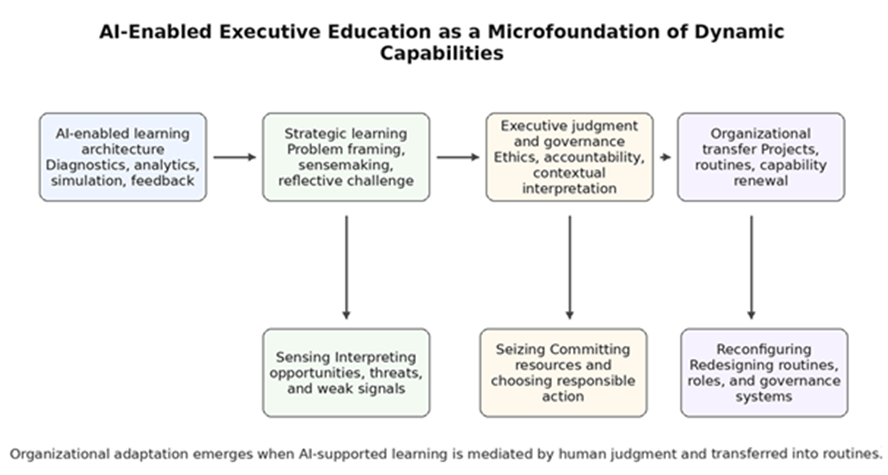
Figure 1. Conceptual model of executive education enabled by artificial intelligence. The model demonstrates how an AI-enabled learning architecture can facilitate organizational adaptation when strategic learning is affected by executive judgment, governance, and organizational transfer.
4. Methodology
The methodology of the study is qualitative conceptual on the basis of the integrative synthesis of peer-reviewed academic literature. Conceptual methodology can be applied when a phenomenon emerges in different bodies of knowledge but lacks a combined theory. The relationship between artificial intelligence and executive education satisfies this condition, as the relevant research is scattered across management information systems, organization studies, strategic management, leadership development, adult learning, and organizational learning.
The review logic was a structured conceptual synthesis rather than a full systematic review. The aim was theory development not full bibliometric mapping. The literature was identified by searching major academic databases and scholarly indexing platforms such as Scopus, Web of Science, EBSCO, ScienceDirect, Emerald, Taylor & Francis, SpringerLink and Google Scholar. The search terms were a combination of the following keyword groups: “artificial intelligence” OR “generative AI” OR “algorithmic management” OR “learning analytics”; “executive education” OR “management education” OR “leadership development”; “organizational learning” OR “learning transfer” OR “adult learning”; “dynamic capabilities” OR “sensing, seizing, reconfiguring”; “AI governance” OR “responsible AI” OR “algorithmic accountability”. The literature was selected from five thematic domains: artificial intelligence in organizations, executive education and leadership development, organizational learning and learning transfer, dynamic capabilities, and algorithmic governance. Foundational sources were chosen if they establish the theoretical base for the study and recent sources from 2022 onwards were chosen if they discuss generative AI, AI literacy, responsible AI, learning analytics and AI-enabled educational transformation.
The inclusion logic was based on four criteria. Sources must be conceptually relevant to the research questions to start with. Secondly, they had to contribute to one of the analytical domains of the study. Third, they had to be published in peer-reviewed journals or in recognized academic books where basic theory was required. Fourth, they needed to help explain mechanisms, not just describe technological trends. Purely promotional sources, practitioner-only sources, sources without theoretical underpinnings, and sources that dealt with technical model performance and not leadership or organizational learning implications were excluded.
The synthesis was based on conceptual relevance, theoretical quality, and explanatory value. Sources were not regarded as equivalent pieces of evidence but as contributions to theory building. The core constructs were defined using foundational works, and the argument was refined based on generative AI, responsible AI, AI literacy, and data-intensive learning environments by referring to recent studies. This is a suitable approach for a conceptual study, as the goal is to integrate fragmented literatures and suggest propositions that can be tested in future empirical research.
The synthesis was performed in four analytical steps . First, key concepts were extracted from the selected literature, such as augmentation, automation, strategic learning, psychological safety, sensing, seizing, reconfiguring, learning transfer, ethical accountability and algorithmic control. Second, these concepts were compared across literatures to reveal tensions and complementarities. Third, the dynamic capabilities theory has been used to structure the relationship between executive education and organizational adaptation. Fourth, the analysis produced a conceptual model and theoretical propositions connecting AI-enabled executive education to strategic learning, leadership development, and organizational renewal.
The method is analytical not empirical. It does not claim to test hypotheses or to report primary data. It is intended to be a theoretical generalization, to develop a conceptual explanation to guide future empirical research and practical program design. Hence the quality of the analysis depends on conceptual clarity, coherence, critical comparison, and the strength of the theoretical contribution.
The study has limitations. It is designed for executive education for experienced leaders and managers, not for general higher education or for technical training. It explores artificial intelligence as an educational and organizational force, not just a technical discipline. It also stresses organizational change and strategic learning rather than platform design or instructional technology per se. These boundaries enable the study to make a particular argument rather than a general description of digital education.
Table 1. Conceptual synthesis design
Analytical domain | Selection focus | Conceptual purpose | Contribution to the argument |
AI in organizations | Peer-reviewed research on decision-making, augmentation, algorithmic control and governance. | To characterize the organizational impacts of intelligent systems | Shows why interpretation and accountability are an integral part of executive learning |
Leadership development and executive education | Learning, leadership capacity, adult learning and managerial practice research | Position executive education as strategic learning and leadership development. | Describes how senior leaders develop judgment and adaptive capability |
Learning and transfer in the organization | Basic work on experience, exploration, exploitation, knowledge creation and transfer | To link individual learning to organizational knowledge | Explains the importance of transfer of learning in executive education |
Dynamic capabilities | Foundational and learning-based research on sensing, seizing and reconfiguring | To offer the theoretical framework | Explains how executive education can serve as a microfoundation of adaptation |
Algorithmic governance | Accountability, bias, transparency, control and human agency studies | To incorporate ethical and organizational risk into the model | Why governance is not separate from learning, but part of leadership development |
Note. The table summarizes the logic used to select and synthesize literature for conceptual theory development.
5. Analysis
5.1 Strategic Learning Transformation
Artificial intelligence changes the conditions of strategic learning and transforms executive education. In traditional executive programs learning is through lectures, cases, peer exchange, coaching and reflection. These methods are still useful because executive learning is highly social and interpretive. But artificial intelligence opens new perspectives for adaptive diagnosis, personalized learning paths, simulation and feedback. The result is not only a more efficient programme. It is a different learning architecture.
One of the most visible changes is personalization. Executives from different industries, functions, leadership histories and strategic problems enter the programs. AI can help with diagnostic assessment and adaptive learning pathways to identify knowledge gaps and suggest relevant content. Recent work in learning analytics and generative AI also suggests the potential for AI-enabled learning environments to support professional competencies when analytics are employed to foster reflection, feedback and self-regulated development as opposed to simply monitoring performance (Barthakur et al., 2026). This can add to the relevance of executive education, particularly for participants with particular transformation challenges. But personalization must not mean intellectual narrowing. If systems learn solely from existing profiles and preferences, then they may reinforce existing assumptions. The best executive education must be personalized and yet expose executives to unfamiliar ideas, critical perspectives and strategic discomfort.
Another big difference is feedback. Executives tend to learn by experience, but experience does not always mean learning. Experience becomes knowledge through feedback. Artificial intelligence can give you structured feedback on your decisions, communication patterns, negotiation choices or scenario outcomes. It can also let executives experiment with strategic assumptions in simulated environments. Such feedback can be learning-promoting if it is not an ultimate judgment but the basis for reflection.
AI also changes the relationship between learning and organizational reality. Anonymized data, strategic projects and scenario-based work can connect executive education to real organizational problems. This promotes transfer as learning is not separated from action. Executives can explore issues directly relevant to their companies, test different responses and come back with a better sense of implementation. This is where executive education begins to become a strategic learning infrastructure.
Still, the danger of a shallow acceleration is there. Intelligent systems can accelerate learning, but accelerated learning does not always mean deeper learning. Strategic learning takes time to reflect, to question assumptions and to discuss meaning with others. If dashboards, scores and automated recommendations dominate executive education it might limit the depth of reflection leaders need. The design challenge is thus to use artificial intelligence to enrich learning, not to reduce it to measurable indicators alone.
5.2 Leadership Transformation Development
AI changes the nature of executive judgment, and therefore changes the nature of leadership development. Leaders are more and more often employing systems that make predictions, classify risk, suggest actions and assess performance. The leadership task is no longer confined to making decisions with human advice. It includes interpreting analysis from machines and deciding how much authority it should have.
The central leadership skill is judgment informed by data. This is not the same as technical expertise. Executives don’t need to be software engineers or data scientists to lead responsibly. They must understand how data can support decisions, how models can fail, how bias can creep into systems, and how uncertainty should be communicated. Data-informed judgment is the fusion of analytical literacy and practical wisdom. This is strongly connected to AI literacy, which has recently been defined in research as the ability to understand, evaluate, use and critically question AI systems in educational and professional contexts (Laupichler et al., 2022; Wolters, 2024). And it helps leaders ask better questions rather than passively accept outputs.
Ethical reasoning is also important. Artificial intelligence impacts people in hiring, promotion, surveillance, customer segmentation, credit decisions, health decisions, public services, and performance management. Systems can be built for efficiency, but they can have uneven consequences. Therefore, leaders must see accountability, fairness, transparency and privacy as strategic issues. These issues should be at the heart of leadership development, not siloed into compliance topics, in executive education.
Adaptive leadership is needed as well. Artificial intelligence changes roles, skills requirements and professional identities. Employees may be afraid of replacement, loss of autonomy or unfair evaluation. To guide people through these changes, leaders need to be able to build trust, articulate purpose, and drive learning. The importance of psychological safety is that employees need to feel that they can question technology, report errors and suggest improvements. In this sense leadership development must also consider the social conditions of technological change.
And finally, the leaders need strategic communication. Artificial intelligence is often met with excitement and anxiety. Senior leaders need to explain why they are deploying intelligent systems, what problems they are designed to solve, what their constraints are, and how people will remain accountable. Poor communication can cause resistance or unrealistic expectations. Therefore, executive education needs to prepare leaders to craft narratives of responsible transformation.
Table 2. Leadership capabilities required in artificial-intelligence-enabled executive education
Capability | Meaning for executive leadership | Educational design implication |
Judgment informed by data | Ability to use analytical outputs without losing accountability | decision labs scenario planning and critical questioning of data |
Moral reasoning | The ability to identify risks of bias, privacy, fairness, and accountability | Ethical cases; stakeholder analysis and governance design exercises |
Adaptive leadership | Ability to lead people through organizational change and technology | Peer reflection and psychological safety practices in change projects |
Strategic communication | Ability to articulate the purpose, limitations and implications of intelligent systems | Narrative building, transparency activities and board level communication training |
Learning ability | Ability to adapt assumptions and routines to changing conditions | Reflection journals, feedback loops, and post-program application projects |
Note: The abilities combine the dimensions of analysis, ethics, relations, and strategy. They cannot be reduced to technical skills.
5.3 Dynamic Capabilities Microfoundations: Executive Education
The strongest theoretical claim of this research is that executive education can be a microfoundation for dynamic capabilities. Dynamic capabilities do not simply appear at the firm level. They depend on managerial cognition, learning routines, decision processes and organizational practices. Through how it shapes the way leaders sense, seize and reconfigure, executive education can impact each of these mechanisms.
Executive education helps leaders in sensing to recognize and make sense of change. AI can generate richer data and faster pattern recognition, but sensing requires an assessment of relevance. Leaders have to decide which signals to listen to, which trends are ephemeral and which threats need to be dealt with. Scenario learning, industry analysis, simulation and peer comparison in executive education can reinforce this capability.
Executive education helps leaders make strategic decisions when seizing. AI can help in decision-making with forecasts and simulations, but taking advantage requires commitment. Leaders have to put resources on the line, build coalitions and own uncertain choices. In executive education, decision laboratories and live strategic projects and reflective analysis of trade-offs can help in this process.
In reconfiguration, executive education helps leaders redesign routines and structures. AI may reveal skill gaps or patterns of performance, but reconfiguration involves organizational change. Leaders must overcome resistance, redefine roles and embed new practices. Executive education can help with reconfiguration if it contains action learning, organizational projects, and transfer mechanisms after the program.
The analysis indicates that executive education should not be organized only by topics. It has to be built on capability processes. An artificial intelligence program for executives should not just explain technology. It should help participants feel strategic implications, capture responsible opportunities and reconfigure organizational practices. When executive education is designed this way it becomes part of the organization’s adaptive system.
5.4 Critical Tensions, Risk and Governance
There are a number of tensions in AI-powered executive education. The first is personalization against intellectual challenge. Personalization can increase relevance, but it can also shield leaders from discomfort. Executive education must provide leaders with the experience of coming face-to-face with ideas that challenge their assumptions. Otherwise adaptive learning may become adaptive confirmation.
The second tension is analytics vs. judgment. Analytics can help improve decision support, but leadership cannot be reduced to calculation. Strategically important decisions are about values, uncertainty, stakeholder conflict and responsibility. Executive education has to teach leaders how to use analytics as evidence, not as authority. The final responsibility for action rests with people and organizations.
The third is speed versus reflection. This tension is particularly relevant in generative AI settings, where rapid access to well-formed responses can create an illusion of understanding, but not necessarily lead to deeper learning, critical thinking, or responsible use (Kasneci et al., 2023; Bobula, 2024). Artificial intelligence can speed up learning, but reflection often requires slowness. Executives need time to interpret experience, to talk about ambiguity, to glean consequences. A program that focuses too much on speed may produce shallower learning. The best design is one where artificial intelligence fosters better conditions for reflection, and doesn't eliminate it.
The fourth tension is between automation and accountability. When systems suggest or make decisions accountability can get fuzzy. Leaders may blame technology for the results, and technical teams may say that the decisions are up to management. Executive education should help leaders build accountability structures before issues arise. Learning has to be built into governance.
The fifth tension is individual development vs. organization transfer. Executive education often improves the knowledge of the individual, but for organizational change this needs to be transferred into routines, teams and strategy. Artificial intelligence can assist in tracking learning and supporting follow-up, but transfer requires leadership support, incentives, and implementation structures. Absent this, executive education remains symbolic rather than transformative.

Figure 2. Design tensions in AI-powered executive education The figure shows five tensions that need to be balanced for AI to strengthen rather than weaken executive education.
6. Theoretical Propositions
The analysis can be stated formally in six propositions. These propositions are offered for future empirical testing and conceptual refinement. They translate the study’s argument into theory-building statements connecting AI-enabled executive education and dynamic capabilities.
Table 3. Propositions connecting artificial-intelligence-powered executive education to dynamic capabilities.
Proposition | Theory-building statement |
Proposition 1 | Executive education that is powered by AI improves organizational sensing when reflective sensemaking is integrated with adaptive diagnostics, data-rich scenarios, and peer interpretation, rather than treated as separate information tools. |
Proposition 2 | AI-enabled executive education improves strategic seizing if simulations and decision-support tools are connected with actual resource-allocation decisions, stakeholder analysis, and responsible leadership judgment. |
Proposition 3 | AI-enabled executive education strengthens organizational reconfiguring when post-program transfer mechanisms link individual learning to routines, roles, governance systems, and transformation projects. |
Proposition 4 | Executive judgment is a mediator of the relationship between AI-enabled executive education and dynamic capabilities such as the ability to interrogate algorithmic output, interpret uncertainty and accept accountability for strategic action. |
Proposition 5 | The design of AI-enabled executive education programs will be most conducive to organizational adaptation when it balances personalization with intellectual challenge, analytics with judgment, speed with reflection, and automation with accountability. |
Proposition 6 | The creation of strategic value through AI-enabled executive education is less likely where learning analytics are used predominantly for measurement and compliance rather than for reflection, dialogue, ethical governance, and organizational transfer. |
Note. The table summarizes the six theoretical propositions that have been formulated on the basis of the conceptual synthesis. The propositions provide insights into how AI-enabled executive education can support sensing, seizing, and reconfiguring capabilities via executive judgment, reflective learning, governance, and organizational transfer. These propositions are meant to be empirically tested and conceptually refined in the future.
7. Discussion
The findings imply that artificial intelligence does not simply update executive education. It shifts its strategic role. Executive education becomes more critical as leaders have to lead organizations through the process of technological change, but it also becomes more demanding because learning has to be embedded in governance, judgment and organizational transformation. This makes executive education a key site where technology, leadership and strategy meet.
The first theoretical contribution of the study is to position executive education as a microfoundation of dynamic capabilities. While dynamic capabilities theory speaks to adaptation at the organizational level, it also calls for attention to the learning and judgement of leaders. Executive education can influence these microfoundations by building the cognitive, relational, and governance capacities that enable leaders to sense, seize, and reconfigure. Artificial intelligence reinforces that role by providing richer data, feedback and simulation, but only if these tools are linked to strategic reflection and action.
Second, it clarifies the leadership implications of artificial intelligence. The study questions the notion that the main job is to make executives technically expert. Technical literacy is important but leadership in AI-enabled organizations is more fundamentally a matter of judgment. Leaders need to know how to measure outputs, how to manage risk, how to manage change, how to defend human responsibility. This extends the complementarity perspective proposed by Jarrahi (2018) to the executive education domain.
The third contribution is to identify design tensions to be managed. There is a lot of talk about artificial intelligence in education and much of it is around personalization, efficiency and analytics. These are important, but not enough for executive education. Senior leaders need intellectual challenge, ethical reflection, peer dialogue and organizational transfer. In this way, the proposed model balances personalization and stretch, analytics and judgment, speed and reflection, automation and accountability, and individual development and organizational change.
Practical implications are important. Business schools and executive education providers need to redesign programs around strategic capability, not just coverage of topics. Programs should feature diagnostic assessment, adaptive content, simulations, cases involving ethical decision-making, live organizational projects, peer dialogue and post program transfer support. Faculty positions can also change. Technology does not replace faculty, it makes them interpreters, facilitators, challengers and designers of reflective learning environments.
Organizations should also change the way they buy and use executive education. They should connect it to transformation agendas, rather than seeing it as an individual manager benefit. Prior to the start of the program, organizations should identify the strategic capabilities they need to develop. During the program, participants will work on live organizational challenges. After the program, leaders are expected to use what they have learned to projects, changes in governance and new routines. This makes executive education a strategic investment rather than a symbolic exercise.
There are implications for assessment too. Artificial intelligence allows you to measure participation, progress and some types of learning transfer. But leadership development cannot be reduced to measurable indicators. Some outcomes are hard to measure, like ethical responsibility, strategic courage, trust building, and wise judgment. Therefore high-quality research and practice should not involve simplistic measurement. Assessment should be a blend of analytics alongside qualitative evidence, such as peer feedback, reflective writing and evidence of application to the organisation.
The discussion ends with a normative point. Executive education should not treat artificial intelligence as an unstoppable force that leaders need to simply adapt to. Leaders also shape the design, governance, and institutionalization of technology. Executive education is therefore not only adaptation to technology but responsible agency in technological change.
Table 4. Practical design principles for AI-enabled executive education
AI-enabled design feature | Leadership capability developed | Dynamic capability supported | Main risk | Mitigation strategy |
Adaptive diagnostics | Self-awareness and learning ability | Sensing | Limited Personalisation | Add challenging cross function content |
AI-supported simulations | Strategic decision making | Seizing | Dependence on model outputs | Require human justification of decisions |
Learning analytics | Reflective Learning and Transference | Reconfiguring | Measurement without meaning | Blend analytics with coaching and reflection |
Ethical AI cases | Responsible Decision Making | Sensing and seizing | Considering ethics as mere compliance | Make use of stakeholder analysis |
Live organizational projects | Change leadership | Reconfiguring | Weak transfer after the program | Link Projects to Org Sponsors |
Peer dialogue and faculty facilitation | Critical thinking and communication skills | Sensing, seizing, and reconfiguring | Loss of social learning from AI-mediated formats | Reserve time for discussion debate and reflection |
Note. The table translates the conceptual argument of the study into practical design principles for AI-powered executive education. It demonstrates that the use of AI tools must be linked not only to efficiency, automation, or measurement, but to leadership capability development, building of dynamic capability, ethical reflection, and organizational transfer. Mitigation strategies highlight the need for a balance between technological support, human judgement, peer-to-peer discussion, faculty facilitation and responsible governance.
8. Implications for Future Research
Future research should empirically test the conceptual model proposed in this study. One area of research is looking at whether AI-enabled executive education improves sensing, seizing and reconfiguring capabilities more effectively than traditional program designs. Studies across industries may indicate where the model is most useful and where it seems to have its limits.
A second direction is the study of transfer of learning. While many executive programs elicit favorable participant reactions, little is known about how learning becomes organizational change. Further research needs to explore the conditions under which AI-enabled feedback, simulation and coaching impact real strategic decision-making, team routines and transformation outcomes.
A third direction is to look at governance. Research is needed to understand how executive education can improve leaders’ ability to recognize bias, design for accountability, and communicate responsible use of intelligent systems. This is particularly important in sectors where decisions affect employment, finance, health, public services or education.
A fourth direction is to explore the social experience of executive learning. AI can be personalizing learning but executive education also depends on peer dialogue, trust and reflection. Future research should explore how technology alters these social processes and how hybrid program designs can preserve their value.
A fifth avenue is to explore variation across organizational and institutional contexts. AI-supported executive education may be somewhat different in large corporations, public-sector organizations, entrepreneurial firms, professional-service organizations, and transnational education contexts. Hence, it is important for future research to investigate contextual variation rather than assume a single model of AI-enabled leadership learning.
9. Limitations
Limitations of this study are: First, it is a conceptual study and it does not empirically test the proposed model. Its propositions need more qualitative, quantitative, and mixed methods research. Second, the study synthesizes several literatures, but it does not claim to be a systematic review. It is a contribution to the development of theory rather than an exhaustive treatment. Third, the analysis is based on executive education and may not be directly transferable to undergraduate business education, technical training, or general online learning. Fourth, as a rapidly changing field, the design principles suggested here should be revisited as tools, regulations, and organizational practices evolve.
These limitations do not lessen the importance of the conceptual argument. Instead they set the next stage of research. Practice is moving faster than scholarship. There is a need for theoretical integration. Executive education providers and organizations are already experimenting with AI-enabled learning systems, but there is little theoretical foundation for assessing their strategic value.
10. Conclusion
Artificial intelligence is transforming executive education, not only in the knowledge gained about leadership but also in how learning is designed. This study has argued for an interpretation of the transformation in terms of dynamic capabilities theory. Strategic value of executive education is when it enables organizations to sense change, to seize opportunities and reconfigure routines, roles and capabilities. Artificial intelligence can assist this process through personalization, feedback, simulation, analytics and learning transfer. But its value is not a given.
The central finding is that AI improves executive education only when it is mediated by human judgment and ethical governance. The future of executive education is not about fully automated learning for senior leaders. It should be seen as an intelligent learning system, more reflective and more strategically connected. Such a system harnesses technology to enhance the evidence and the feedback, but it preserves the human purposes of executive education: judgment, responsibility, dialogue and action.
The study contributes to theory by conceptualizing executive education as a micro-foundation for dynamic capabilities. It aids leadership development by demonstrating that data-driven judgment is a critical executive competency. This contributes to practice by providing principles for the design of AI-enabled executive education that balance efficiency with depth and automation with accountability.
So the transformation of executive education is not just about technology. This is a matter of institution and strategy. Organizations need leaders who understand intelligent systems, manage their risks, and use them to facilitate responsible adaptation. Executive education is a key element in developing these leaders. Its future value will depend on its ability to rise above content delivery and become a disciplined space for strategic learning, ethical leadership and organizational renewal.
References
Argote, L., & Miron-Spektor, E. (2011). Organizational learning: From experience to knowledge. Organization Science, 22(5), 1123-1137. https://doi.org/10.1287/orsc.1100.0621
Baldwin, T. T., & Ford, J. K. (1988). Transfer of training: A review and directions for future research. Personnel Psychology, 41(1), 63-105. https://doi.org/10.1111/j.1744-6570.1988.tb00632.x
Barthakur, A., Viberg, O., Kizilcec, R. F., Baker, R. S., & Dawson, S. (2026). Advancing 21st-century professional competencies with learning analytics in the age of generative AI. Journal of Learning Analytics, 13(1), 1–6. https://doi.org/10.18608/jla.2026.9743
Berente, N., Gu, B., Recker, J., & Santhanam, R. (2021). Managing artificial intelligence. MIS Quarterly, 45(3), 1433-1450. https://doi.org/10.25300/MISQ/2021/16274
Bobula, M. (2024). Generative artificial intelligence (AI) in higher education: A comprehensive review of challenges, opportunities, and implications. Journal of Learning Development in Higher Education, 30.
Conger, J. A., & Xin, K. (2000). Executive education in the 21st century. Journal of Management Education, 24(1), 73-101. https://doi.org/10.1177/105256290002400106
Duan, Y., Edwards, J. S., & Dwivedi, Y. K. (2019). Artificial intelligence for decision making in the era of big data: Evolution, challenges and research agenda. International Journal of Information Management, 48, 63-71. https://doi.org/10.1016/j.ijinfomgt.2019.01.021
Dwivedi, Y. K., Hughes, L., Ismagilova, E., Aarts, G., Coombs, C., Crick, T., Duan, Y., Dwivedi, R., Edwards, J., Eirug, A., Galanos, V., Ilavarasan, P. V., Janssen, M., Jones, P., Kar, A. K., Kizgin, H., Kronemann, B., Lal, B., Lucini, B., ... Williams, M. D. (2021). Artificial intelligence: Multidisciplinary perspectives on emerging challenges, opportunities, and agenda for research, practice and policy. International Journal of Information Management, 57, Article 101994. https://doi.org/10.1016/j.ijinfomgt.2019.08.002
Dwivedi, Y. K., Kshetri, N., Hughes, L., Slade, E. L., Jeyaraj, A., Kar, A. K., Baabdullah, A. M., Koohang, A., Raghavan, V., Ahuja, M., Albanna, H., Albashrawi, M. A., Al-Busaidi, A. S., Balakrishnan, J., Barlette, Y., Basu, S., Bose, I., Brooks, L., Buhalis, D., ... Wright, R. (2023). “So what if ChatGPT wrote it?” Multidisciplinary perspectives on opportunities, challenges and implications of generative conversational AI for research, practice and policy. International Journal of Information Management, 71, Article 102642. https://doi.org/10.1016/j.ijinfomgt.2023.102642
Edmondson, A. (1999). Psychological safety and learning behavior in work teams. Administrative Science Quarterly, 44(2), 350-383. https://doi.org/10.2307/2666999
Eisenhardt, K. M., & Martin, J. A. (2000). Dynamic capabilities: What are they? Strategic Management Journal, 21(10-11), 1105-1121. https://doi.org/10.1002/1097-0266(200010/11)21:10/11%3C1105::AID-SMJ133%3E3.0.CO;2-E
Faraj, S., Pachidi, S., & Sayegh, K. (2018). Working and organizing in the age of the learning algorithm. Information and Organization, 28(1), 62-70. https://doi.org/10.1016/j.infoandorg.2018.02.005
Haenlein, M., & Kaplan, A. (2019). A brief history of artificial intelligence: On the past, present, and future of artificial intelligence. California Management Review, 61(4), 5-14. https://doi.org/10.1177/0008125619864925
Jarrahi, M. H. (2018). Artificial intelligence and the future of work: Human-artificial intelligence symbiosis in organizational decision making. Business Horizons, 61(4), 577-586. https://doi.org/10.1016/j.bushor.2018.03.007
Kasneci, E., Seßler, K., Küchemann, S., Bannert, M., Dementieva, D., Fischer, F., Gasser, U., Groh, G., Günnemann, S., Hüllermeier, E., Krusche, S., Kutyniok, G., Michaeli, T., Nerdel, C., Pfeffer, J., Poquet, O., Sailer, M., Schmidt, A., Seidel, T., ... Kasneci, G. (2023). ChatGPT for good? On opportunities and challenges of large language models for education. Learning and Individual Differences, 103, Article 102274. https://doi.org/10.1016/j.lindif.2023.102274
Kellogg, K. C., Valentine, M. A., & Christin, A. (2020). Algorithms at work: The new contested terrain of control. Academy of Management Annals, 14(1), 366-410. https://doi.org/10.5465/annals.2018.0174
Kolb, D. A. (1984). Experiential learning: Experience as the source of learning and development. Prentice Hall.
Knowles, M. S., Holton, E. F., & Swanson, R. A. (2015). The adult learner: The definitive classic in adult education and human resource development (8th ed.). Routledge.
Lacerenza, C. N., Reyes, D. L., Marlow, S. L., Joseph, D. L., & Salas, E. (2017). Leadership training design, delivery, and implementation: A meta-analysis. Journal of Applied Psychology, 102(12), 1686-1718. https://doi.org/10.1037/apl0000241
Laupichler, M. C., Aster, A., Schirch, J., & Raupach, T. (2022). Artificial intelligence literacy in higher and adult education: A scoping literature review. Computers and Education: Artificial Intelligence, 3, Article 100101. https://doi.org/10.1016/j.caeai.2022.100101
March, J. G. (1991). Exploration and exploitation in organizational learning. Organization Science, 2(1), 71-87. https://doi.org/10.1287/orsc.2.1.71
Mezirow, J. (1991). Transformative dimensions of adult learning. Jossey-Bass.
Mintzberg, H. (2004). Managers not MBAs: A hard look at the soft practice of managing and management development. Berrett-Koehler.
Nah, F. F.-H., Zheng, R., Cai, J., Siau, K., & Chen, L. (2023). Generative AI and ChatGPT: Applications, challenges, and AI-human collaboration. Journal of Information Technology Case and Application Research, 25(3), 277–304. https://doi.org/10.1080/15228053.2023.2233814
Nonaka, I. (1994). A dynamic theory of organizational knowledge creation. Organization Science, 5(1), 14-37. https://doi.org/10.1287/orsc.5.1.14
Raisch, S., & Birkinshaw, J. (2008). Organizational ambidexterity: Antecedents, outcomes, and moderators. Journal of Management, 34(3), 375-409. https://doi.org/10.1177/0149206308316058
Raisch, S., & Krakowski, S. (2021). Artificial intelligence and management: The automation-augmentation paradox. Academy of Management Review, 46(1), 192-210. https://doi.org/10.5465/amr.2018.0072
Salas, E., Tannenbaum, S. I., Kraiger, K., & Smith-Jentsch, K. A. (2012). The science of training and development in organizations: What matters in practice. Psychological Science in the Public Interest, 13(2), 74-101. https://doi.org/10.1177/1529100612436661
Shrestha, Y. R., Ben-Menahem, S. M., & von Krogh, G. (2019). Organizational decision-making structures in the age of artificial intelligence. California Management Review, 61(4), 66-83. https://doi.org/10.1177/0008125619862257
Teece, D. J. (2007). Explicating dynamic capabilities: The nature and microfoundations of sustainable enterprise performance. Strategic Management Journal, 28(13), 1319-1350. https://doi.org/10.1002/smj.640
Teece, D. J., Pisano, G., & Shuen, A. (1997). Dynamic capabilities and strategic management. Strategic Management Journal, 18(7), 509-533. https://doi.org/10.1002/(SICI)1097-0266(199708)18:7%3C509::AID-SMJ882%3E3.0.CO;2-Z
von Krogh, G. (2018). Artificial intelligence in organizations: New opportunities for phenomenon-based theorizing. Academy of Management Discoveries, 4(4), 404-409. https://doi.org/10.5465/amd.2018.0084
Wolters, A. (2024). AI literacy in adult education: A literature review. Proceedings of the Hawaii International Conference on System Sciences.
Zollo, M., & Winter, S. G. (2002). Deliberate learning and the evolution of dynamic capabilities. Organization Science, 13(3), 339-351. https://doi.org/10.1287/orsc.13.3.339.2780


Comments