.png)


Strategic Cross-Border Academic Partnerships: A Review of Evolving QA Standards and Benchmarking
Author: Emma Dubois
Affiliation: Swiss International University (SIU)
ORCID ID: 0009-0001-8464-158X
Submitted 05 April 2026; Revised 02 June 2026; Accepted 17 July 2026; Available online 08 August 2026; Version of Record 08 August 2026.
Doi: https://doi.org/10.65326/u7y.SpecSDG10001
Volume 3, December 2026, (SpecSDG10001)

Abstract
Cross-border academic partnerships now carry a substantial share of the world's internationally delivered higher education, yet the rules that assure their quality have been written in several places at once: intergovernmental guidelines, regional standards, national accreditation regimes, and the informal discipline of rankings and benchmarking. This article presents an integrative review of peer-reviewed scholarship and documented policy instruments published between 2005 and 2026, combined into a conceptual account of how formal quality assurance standards and comparative benchmarking jointly steer partnership strategy. The review traces the evolution of the principal instruments, from the OECD and UNESCO guidelines of 2005 through the European Standards and Guidelines, the European Approach for Quality Assurance of Joint Programmes, the UNESCO Global Convention on recognition, and the INQAAHE international standards, and reads them against the management literature on branch campuses, franchised provision, and joint programmes. Three findings organise the argument. First, formal standards have moved from consumer protection toward trust-based, mode-neutral frameworks that allocate responsibility between sending and receiving systems. Second, benchmarking and rankings operate as a parallel, non-mandated governance channel that shapes partner selection and institutional behaviour while measuring partnership quality only weakly. Third, national regimes translate shared standards selectively, so partnerships face layered and sometimes duplicated requirements. The article contributes a multi-level framework linking partnership strategy, standards, and benchmarking, and identifies implications for institutions, agencies, and policy makers.
Keywords: transnational higher education, quality assurance, cross-border partnerships, benchmarking, accreditation, international branch campuses, joint degrees
1. Introduction
Universities increasingly pursue their international ambitions through partnerships that cross jurisdictions: franchised programmes, jointly awarded degrees, co-founded institutions, and branch campuses established on foreign soil. These arrangements have grown from a peripheral activity into a recognised mode of provision with its own vocabulary, data problems, and regulatory politics (Knight, 2016). Their scale is no longer trivial. Reviews of the branch campus sector counted more than two hundred such campuses worldwide by the mid-2010s, concentrated in the Middle East and South-east Asia (Healey, 2015), and one systematic mapping recorded a peak of 249 campuses across thirty-three countries in January 2017 (Escrivá-Beltran et al., 2019). In the United Kingdom, the largest sending system, roughly 700,000 students were studying for UK qualifications in their own countries in 2017/18, more than twice the number of non-European Union students who travelled to the UK to study (Healey, 2020).
Growth of this kind places unusual demands on quality assurance. A degree taught in one country under the academic authority of an institution in another sits at the intersection of two regulatory systems, two labour markets, and often two sets of accreditation requirements. The instruments designed to govern this intersection have multiplied since the mid-2000s: the OECD and UNESCO issued joint guidelines on cross-border provision in 2005 (OECD & UNESCO, 2005); the European Higher Education Area revised its Standards and Guidelines in 2015 and adopted a dedicated European Approach for the external evaluation of joint programmes in the same year (EHEA, 2015; ENQA et al., 2015); UNESCO's Global Convention on the recognition of higher education qualifications was adopted in 2019 and entered into force in 2023 (UNESCO, 2019); and the international network of quality assurance agencies issued global standards for external quality assurance providers, including a module on cross-border activity, in 2022 (INQAAHE, 2022). Alongside this formal architecture, a second and less orderly set of comparative instruments has come to influence the same decisions. Global rankings and institutional benchmarking shape which partners institutions consider credible, how governments frame excellence, and how quality itself is argued about in public (Hazelkorn, 2015; Marginson, 2014; Musselin, 2018).
The scholarly literatures that examine these developments have grown up largely in separate rooms. Research on transnational education has been reviewed as a field in its own right, with well-mapped clusters on management, pedagogy, and policy (Kosmützky & Putty, 2016), and the branch campus literature has been synthesised repeatedly from an institutional and stakeholder perspective (Escrivá-Beltran et al., 2019; Wilkins, 2021). Quality assurance scholarship, for its part, has concentrated on domestic systems: how agencies translate shared European standards into national frameworks (Manatos & Huisman, 2020), what makes internal quality management effective (Seyfried & Pohlenz, 2018), and how far evidence can support quality assurance policy at all (Beerkens, 2018). The rankings literature has analysed comparative instruments as policy discourse and as competition infrastructure (Erkkilä, 2014; Musselin, 2018), but rarely in connection with the quality assurance of partnerships. What the literature has not resolved is how these two governance channels, formal standards and comparative benchmarking, interact when they bear on the same object: the strategic cross-border partnership. This gap matters for institutional leaders who must satisfy layered accreditation requirements while competing for reputationally attractive partners, for quality assurance agencies asked to review provision delivered far from their jurisdiction, and for policy makers deciding whether recognition and quality instruments should converge globally or remain regional.
This article addresses that gap through an integrative review with a conceptual contribution. It asks three questions. First, how have formal quality assurance standards and instruments for cross-border provision evolved since 2005, and through what mechanisms do they govern partnerships (RQ1)? Second, how does benchmarking, including global rankings, operate as a parallel governance instrument shaping partnership strategy and quality practice (RQ2)? Third, what quality assurance demands do different partnership models generate, and where do the resulting arrangements converge or diverge across institutional, national, and supranational levels (RQ3)? The contribution is twofold: a synthesis that reads the policy instruments and the management scholarship against each other, and a conceptual framework that locates partnership strategy within the joint operation of standards-based and benchmarking-based steering.
The article proceeds as follows. The next section situates the review in the literatures on internationalisation, quality assurance, and comparative instruments, and sharpens the gap. The Method section sets out the review protocol. The Findings section develops four themes: the evolution of formal standards, benchmarking as governance, the quality assurance demands of partnership models, and convergence and divergence across levels. The Discussion draws theoretical and practical implications, states the limitations of the approach, and identifies the questions that remain open.
2. Background and Conceptual Orientation
2.1. Internationalisation and the Rise of Partnership-Based Provision
Internationalisation is best understood as the set of policies and practices through which academic systems and institutions respond to a global academic environment, driven by motives that range from commercial advantage to knowledge acquisition and curriculum enrichment (Altbach & Knight, 2007). Over five decades it has moved from the margins of institutional life to the centre of reform agendas, and its instruments have diversified accordingly (de Wit & Altbach, 2021). Within this broader movement, the mobility of programmes and providers, rather than students, constitutes a distinct strand. Knight (2016) argues that this strand changed dramatically in scope and scale during the 2010s, generating new actors, new partnership forms, and a proliferation of overlapping terms whose confusion carries real costs for quality assurance, enrolment planning, and regulation. The classification developed for the British Council and the German Academic Exchange Service brings order to this variety by distinguishing independent provision, in which the sending institution retains responsibility for design, delivery, and external quality assurance, from collaborative provision, in which sending and host institutions share those responsibilities, and by sorting programme and provider mobility into six categories on that basis (Knight & McNamara, 2017).
Bibliometric work confirms that scholarship followed practice. Kosmützky and Putty (2016) show that research on transnational, offshore, cross-border, and borderless higher education consolidated into a recognisable thematic field from the early 2000s, with identifiable topic clusters and citation structures. The branch campus, as the most capital-intensive partnership-adjacent form, has attracted particular attention: institutional-theory accounts explain campus establishment through considerations of legitimacy, status, institutional distance, risk, and revenue (Wilkins & Huisman, 2012), while management-oriented reviews emphasise the difficulty of balancing stakeholders that include home-country quality regulators, host governments, and local joint-venture partners (Healey, 2015). Two decades of development have produced both expansion and failure, and continued viability appears to depend on sustained benefit to students, institutions, and host governments alike (Wilkins, 2021).
2.2. Quality Assurance as a Governance Field
Quality assurance occupies an uneasy position between improvement and control. Empirical work on its effectiveness suggests that outcomes depend heavily on organisational conditions: quality managers perceive their work as effective where institutional leadership supports it and where institutions cooperate with one another, and as ineffective where quality assurance is experienced as sanction or administrative burden (Seyfried & Pohlenz, 2018). At the policy level, Beerkens (2018) argues that rigorous ex-post impact evaluation of quality assurance is exceptionally difficult, and that policy should instead cultivate more realistic ways for evidence to inform quality work. These findings caution against treating any standards regime, national or supranational, as self-executing.
The supranational layer has nonetheless thickened. Zapp and Ramirez (2019) document the construction of a global higher education regime along discursive, normative, and regulatory dimensions: a growing network of international organisations, a striking increase in the number of national accreditation agencies and in their mutual cross-national recognition, and parallel growth in qualifications frameworks and regional recognition conventions. Within Europe, the Standards and Guidelines for Quality Assurance in the European Higher Education Area function as the shared reference point for internal quality assurance, external review, and the registration of agencies (ENQA et al., 2015). Yet shared standards are not uniformly applied. Manatos and Huisman (2020) find, across review documentation covering seventeen institutions in four countries, that national quality assurance frameworks often deviate from the European standards through processes of copying and modification, even while review panels stay close to their national frameworks. Translation, not transposition, is the operative mechanism.
2.3. Rankings and Benchmarking as Comparative Instruments
A separate literature treats comparison itself as a governance technology. Hazelkorn (2015) shows that global rankings influence institutional strategy, student choice, and national policy well beyond what their methods warrant. Marginson (2014) evaluates the main ranking systems against social science criteria and concludes that several rest on reputational recycling rather than observable performance, which limits their value as public information. Erkkilä (2014) traces how rankings constructed a policy problem of European higher education, fed convergent reform agendas across countries, and produced stratification and homogenisation as side effects. Musselin (2018) generalises the point: competition in higher education has become institutional and multi-level, organised through impersonal judgment devices, and it generates new classifications and alliances among institutions that compete and cooperate at once. Benchmarking in the narrower managerial sense, structured comparison against peers for improvement, has meanwhile been studied as a quality tool in its own right, with case-based evidence that comparison and assessment can support institutional improvement agendas (Tasopoulou & Tsiotras, 2017). Evidence on the internationalisation indicators inside rankings, however, indicates that their quantitative orientation makes them a poor measure of the quality of international activity (Hauptman Komotar, 2019).
Read together, these literatures leave a specific question unanswered. The transnational education scholarship analyses partnership forms and their management; the quality assurance scholarship analyses standards and their translation; the rankings scholarship analyses comparison and its effects. No study known to this review has integrated the three to explain how formal standards and comparative benchmarking jointly govern strategic cross-border partnerships across institutional, national, and supranational levels. That integration is the task of this article.
3. Method
3.1. Design and Rationale
The study is an integrative review with a conceptual contribution. The integrative review is the appropriate design where the relevant evidence is heterogeneous in method and genre, because it is the review form that permits the combination of empirical and theoretical sources within a single analysis (Whittemore & Knafl, 2005). It is also the form best suited to producing new conceptual structure rather than a pooled effect estimate (Torraco, 2016). A systematic review in the strict sense was rejected because the question spans policy instruments that are not indexed in scholarly databases, and a purely conceptual paper was rejected because the argument depends on the accumulated empirical record. The review followed the staged logic recommended for integrative work: problem identification, literature search, evaluation, analysis, and presentation (Whittemore & Knafl, 2005), with reporting conventions informed by general guidance on review methodology (Snyder, 2019).
3.2. Search Strategy and Selection of Scholarship
Scholarly sources were identified through structured searches of Scopus, Web of Science, and Google Scholar conducted in 2026, covering publications from January 2005 to August 2026, with emphasis on work published from 2016 onward. Example search strings, adapted to each database's syntax, included: ("transnational education" OR "cross-border higher education" OR "international branch campus" OR "joint degree" OR "franchised programme") AND ("quality assurance" OR accreditation OR standards); and (benchmarking OR rankings) AND ("higher education" AND (governance OR internationali*)). Reference lists of retrieved reviews were hand-searched for additional sources.
Inclusion criteria were: (a) peer-reviewed journal articles, research monographs, or edited-volume chapters; (b) direct relevance to at least one of the three research questions, that is, to the quality assurance of cross-border provision, to partnership forms and their management, or to benchmarking and rankings as governance instruments; (c) English language; and (d) conceptual, empirical, or review contributions with an identifiable method or explicit theoretical argument. Exclusion criteria were: (a) purely descriptive practice reports without analytical content; (b) studies of student mobility without a provision or partnership dimension; (c) national case studies with no implication beyond their setting; and (d) sources whose bibliographic details could not be verified against the publisher's or an indexing service's record. Screening proceeded in two stages, title and abstract followed by full text, applying the criteria in that order and retaining methodological anchor works on review method regardless of topic. The final scholarly corpus comprises twenty-six peer-reviewed items spanning higher education studies, comparative education, management, and policy analysis.
3.3. Selection and Treatment of Policy Instruments
Because formal standards are constitutive of the object under review, six documented policy instruments were analysed alongside the scholarship: the OECD and UNESCO guidelines on cross-border provision (OECD & UNESCO, 2005); the European Standards and Guidelines (ENQA et al., 2015); the European Approach for Quality Assurance of Joint Programmes (EHEA, 2015); the transnational education classification framework commissioned by the British Council and DAAD (Knight & McNamara, 2017); the UNESCO Global Convention on recognition (UNESCO, 2019); and the INQAAHE international standards and guidelines (INQAAHE, 2022). Instruments were selected on three criteria: issuance by an intergovernmental body, a ministerial conference, or a recognised international network; explicit applicability to provision or quality assurance that crosses borders; and documented adoption or entry into force. Each instrument was read in its official published version and coded for scope, addressees, mechanism (binding, voluntary, or standard-setting), and treatment of cross-border provision.
3.4. Analysis and Framework Derivation
Analysis followed a thematic synthesis in three passes. The first pass coded each source against the research questions. The second pass grouped codes into candidate themes and tested them against disconfirming sources; for example, claims of global convergence drawn from regime-level scholarship were checked against comparative evidence of national divergence. The third pass arranged the surviving themes into the four findings reported below. The conceptual framework was derived abductively: the levels (supranational, national, institutional) were taken from the structure of the instruments themselves, the two steering channels (standards and benchmarking) from the juxtaposition of the quality assurance and rankings literatures, and the feedback relations from the empirical partnership studies. The framework is interpretive; it organises the reviewed evidence and is not itself a tested model.
3.5. Rigour and Trustworthiness
Several measures limited bias. Every bibliographic record and every quantitative claim carried into the synthesis was verified against the publisher's record, an indexing service, or the issuing organisation's own publication before inclusion, and sources that could not be verified were discarded. Claims are attributed at the strength the underlying study supports, and single-study findings are not presented as consensus. The scope of the review is bounded: it privileges English-language scholarship, which over-represents the perspectives of major sending systems, and it treats policy instruments as texts, not as implemented practice. These boundaries are revisited in the Limitations subsection.
4. Findings
4.1. The Evolution of Formal QA Standards for Cross-Border Provision
The formal architecture governing cross-border provision has passed through three recognisable phases, summarised in Table 1. The first phase was protective. The 2005 guidelines issued jointly by the OECD and UNESCO responded to the rapid growth of provision that escaped national oversight, offering an international framework intended to protect students and other stakeholders from low-quality provision and disreputable providers, and addressing themselves to governments, institutions, quality assurance agencies, and recognition bodies in both sending and receiving countries (OECD & UNESCO, 2005). Their mechanism was voluntary guidance organised around the principle of shared responsibility; they created expectations rather than obligations.
The second phase was regional and trust-based. The 2015 revision of the European Standards and Guidelines, adopted by ministers of the European Higher Education Area at Yerevan, established a mode-neutral principle with direct consequences for partnerships: the standards are designed to apply to all higher education, regardless of place or mode of delivery (ENQA et al., 2015). A degree franchised abroad or taught at a branch campus therefore falls within the same internal and external quality assurance expectations as home provision. In the same year, ministers adopted the European Approach for Quality Assurance of Joint Programmes, which defines standards drawn from agreed European tools and is designed to be used without additional national criteria, so that a joint programme can undergo a single external evaluation rather than parallel accreditations in every partner country (EHEA, 2015). The European Approach is the clearest institutional acknowledgement that partnership-based provision breaks the assumptions of nationally contained quality assurance, and its design principle, one evaluation accepted by many systems, is a template other regions have yet to replicate.
The third phase is global and infrastructural. The classification framework commissioned by the British Council and DAAD supplies the definitional layer that data collection and regulation require, distinguishing collaborative from independent provision and sorting programme and provider mobility into six categories according to who awards the qualification, who designs the curriculum, and who conducts external quality assurance (Knight & McNamara, 2017). The UNESCO Global Convention, adopted in 2019 and in force since March 2023, extends recognition obligations to the global level as the first worldwide legal framework for fair, transparent, and non-discriminatory recognition of qualifications, complementing the existing regional conventions; by 2026 it had been ratified by forty-one states (UNESCO, 2019). The INQAAHE international standards of 2022 complete the picture from the agency side: they set baseline standards for external quality assurance providers across tertiary education and include a dedicated module for cross-border quality assurance and for the quality assurance of provision delivered outside the jurisdiction in which a provider is legally incorporated (INQAAHE, 2022). Answering RQ1, the trajectory runs from consumer protection through regional mutual trust toward a global infrastructure of definitions, recognition law, and agency standards, with the mechanism shifting from exhortation toward standard-setting embedded in registration, recognition, and treaty instruments.
Table 1
International Instruments Governing the Quality Assurance of Cross-Border Higher Education Provision
Instrument (year) | Issuing body | Scope and addressees | Mechanism | Relevance to cross-border partnerships |
Guidelines for Quality Provision in Cross-border Higher Education (2005) | OECD and UNESCO | Global; governments, institutions, QA agencies, recognition bodies in sending and receiving countries | Voluntary guidelines; shared responsibility between systems | First international framework aimed at protecting students from low-quality cross-border provision (OECD & UNESCO, 2005) |
Standards and Guidelines for QA in the EHEA, ESG (2015) | E4 group; adopted by EHEA ministers, Yerevan | EHEA; all higher education regardless of place or mode of delivery | Standard-setting in three parts (internal QA, external QA, agencies); basis for agency registration | Extends home quality assurance expectations to provision delivered abroad (ENQA et al., 2015) |
European Approach for QA of Joint Programmes (2015) | EHEA ministers | Joint programmes within the EHEA | Standards based on agreed EHEA tools, applied without additional national criteria | Enables a single external evaluation of a joint programme across partner systems (EHEA, 2015) |
TNE Classification Framework (2017) | British Council and DAAD | Global; programme and provider mobility in six categories | Common definitions; responsibility sorted by award, curriculum design, and external QA | Distinguishes independent from collaborative provision and clarifies which partner carries QA obligations (Knight & McNamara, 2017) |
Global Convention on the Recognition of Qualifications (2019) | UNESCO | Global; states parties (41 ratifications by 2026) | Binding treaty; entered into force 2023; complements five regional conventions | First worldwide legal framework for fair and transparent recognition of qualifications earned across borders (UNESCO, 2019) |
International Standards and Guidelines, ISG (2022) | INQAAHE | Global; external QA providers across tertiary education (ISCED 4-8) | Baseline standards plus selective modules | Dedicated module on cross-border QA and on QA of provision delivered outside the provider’s jurisdiction (INQAAHE, 2022) |
Note. Compiled from the adopted texts of the instruments as cited in each row; entries summarise scope and mechanism as stated in the official published versions.
4.2. Benchmarking as Governance: The Second Steering Channel
Formal standards are not the only comparative pressure bearing on partnerships. Rankings and benchmarking constitute a second channel that operates without mandate but with considerable force. Hazelkorn (2015) documents how rankings shape institutional strategy, government policy, and student decisions across systems. Erkkilä (2014) shows that in Europe rankings did more than describe: they constructed a policy problem, positioned higher education as an element of economic competitiveness, and fed convergent reform agendas whose side effects include stratification and homogenisation. Musselin (2018) provides the structural reading: competition among universities has become institutional and multi-level, organised through impersonal judgment devices such as rankings and classifications, and it simultaneously produces new alliances among institutions that recognise one another as members of the same category.
This second channel intersects with partnership strategy at several points. The institutional-theory literature on branch campuses identifies status and legitimacy among the principal motives for establishing a foreign presence (Wilkins & Huisman, 2012), and the alliance-formation dynamic that Musselin (2018) describes implies that ranked position conditions who is considered an eligible partner at all. Benchmarking in its managerial form offers a more constructive face: case-based evidence indicates that structured comparison against peers can support quality improvement in universities committed to it (Tasopoulou & Tsiotras, 2017). Yet the measurement base of the comparative channel is weak precisely where partnerships are concerned. Marginson (2014) evaluates the major ranking systems against criteria of materiality, objectivity, and externality and argues that rankings which recycle reputation without connection to observable outputs offer no common value, and Hauptman Komotar (2019) concludes that the internationalisation indicators inside global rankings are too crude to serve as measures of the quality of international activity. The answer this review gives to RQ2 is therefore double-edged: benchmarking steers partnership behaviour, through partner selection, government expectations, and the framing of excellence, while measuring the quality of partnership activity poorly. Institutions respond to a signal that is consequential but only loosely coupled to the educational quality that formal standards address.
4.3. Partnership Models and Their QA Demands
The quality assurance burden a partnership carries depends on its form. The classification distinguishing independent from collaborative provision makes the point structurally: where a sending institution franchises a programme or operates a branch campus, responsibility for design, delivery, and external quality assurance remains primarily with the sender, whereas partnership programmes, joint universities, and jointly awarded degrees distribute those responsibilities across institutions and therefore across regulatory systems (Knight & McNamara, 2017). Each configuration generates a characteristic demand profile.
Independent forms concentrate risk in the sending institution. Branch campuses expose their parents to financial and reputational hazard, and their managers must satisfy home-country quality regulators and host-country authorities simultaneously while answering to local joint-venture partners (Healey, 2015). The strategic literature describes this as dual embeddedness: campuses are pressed to conform to host-country institutions and, at the same time, to preserve the parent's identity and standards. Comparative evidence from Australian and British operations in South-east Asia indicates that campuses resolve this tension unevenly, maintaining close similarity to the parent in curriculum while diverging in staffing, which emerges as the most persistent strategic difficulty (Shams & Huisman, 2016). Because curriculum fidelity is what home quality assurance typically audits, the components most visible to external review may be the best controlled, while the staffing dimension on which teaching quality depends is the hardest to hold to parent standards.
Collaborative forms distribute risk but multiply interfaces. Joint programmes answer to as many external quality assurance regimes as they have degree-awarding partners, which is the duplication the European Approach was designed to remove (EHEA, 2015). Below the level of formal compliance, partnership quality is produced operationally. Bordogna (2018) argues that the transnational education discourse has concentrated on strategic implementation, quality assurance, and pedagogy while neglecting the social relationships among the faculty members who actually deliver collaborative provision, and proposes that partnership development is strengthened where those operational relationships are understood and cultivated. Sustainability pressures cut across both forms: reviews of two decades of branch campus development record failures alongside expansions and conclude that provision persists only while it benefits students, institutions, and host countries at once (Wilkins, 2021), and analysis of the UK sector argues that the high-water mark of transnational enrolment growth may have passed, with growing scepticism about net economic benefit (Healey, 2020). Answering RQ3 in its first part: independent forms demand the extension of home quality systems across borders, collaborative forms demand the coordination of multiple external regimes, and both depend on operational and relational conditions that formal review reaches only indirectly.
4.4. Convergence, Divergence, and the Multi-Level Framework
The final theme concerns how the levels fit together. At the global level, the evidence points to convergence in form. Zapp and Ramirez (2019) document a thickening regime: more international organisations active in higher education, a striking increase in national accreditation agencies and in their mutual recognition, and proliferating qualifications frameworks and recognition conventions. At the level of implementation, however, divergence persists. Manatos and Huisman (2020) show that even within the European Higher Education Area, national frameworks deviate from the shared standards through translation processes of copying and modification. Outside Europe the spread is wider still. Comparative analysis of branch campus regulation in Malaysia, Singapore, China, and South Korea finds that although all four systems expect internal quality mechanisms within campuses, their external approaches split: Singapore and South Korea regulate liberally and rely largely on home-country accreditation, while Malaysia and China subject foreign provision to comprehensive domestic quality assurance processes (Hou et al., 2018). Regional syntheses of Asian practice confirm the variety of arrangements under which transnational provision is assured (Hou et al., 2021). Convergence in form therefore coexists with divergence in practice, and partnerships inhabit the space between: a joint programme or branch campus may face duplicated review, or a regulatory gap, depending on how the systems it spans have translated the common instruments.
Figure 1 integrates the four themes into a conceptual framework. Three levels are distinguished. At the supranational level sit the formal instruments (guidelines, standards, conventions, agency standards) and the comparative infrastructure (rankings, classifications, benchmarking exercises). At the national level, quality assurance regimes translate the formal instruments selectively, while governments import comparative vocabulary into policy targets. At the institutional level, partnership strategy responds to both channels: standards define what a partnership must demonstrate, benchmarking shapes which partnerships are sought and how they are justified. The two channels differ in mechanism, standards operating through review, registration, and recognition, benchmarking through reputation and market signal, but they meet in the partnership, which must satisfy the first while competing on the second. Feedback runs upward as well: partnership practice exposes gaps in standards, as joint programmes did in Europe before 2015 (EHEA, 2015), and institutional competition supplies rankings with their data and their audience (Musselin, 2018). The framework is interpretive rather than predictive; its claim is that neither channel can be understood in isolation when the object of governance is a cross-border partnership.
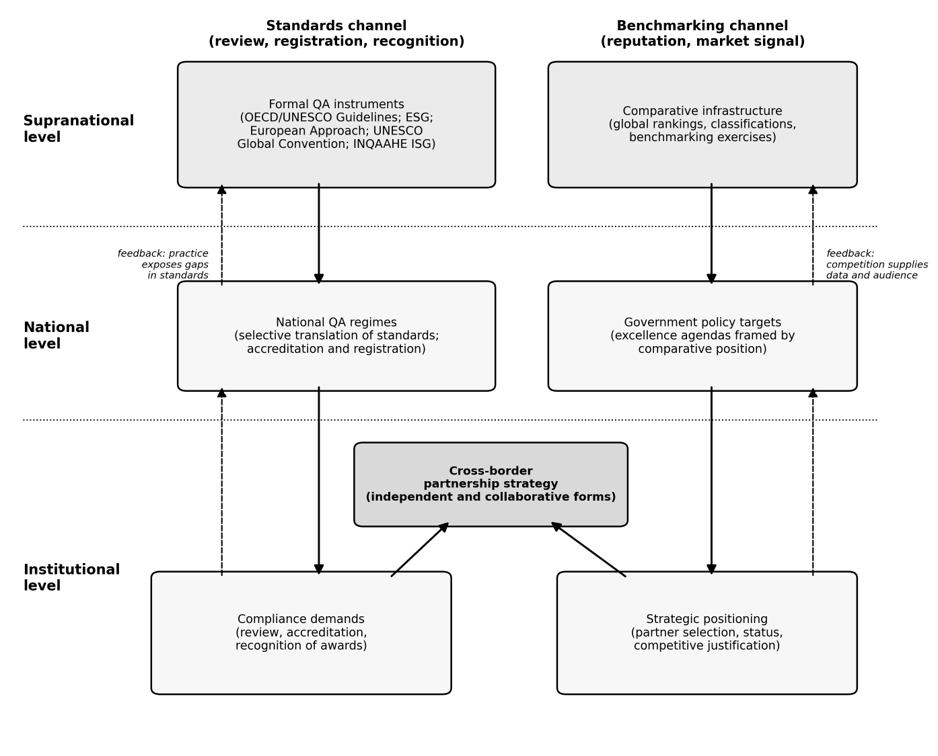
Figure 1. Two-channel, multi-level framework of quality governance for cross-border academic partnerships. Solid arrows denote steering; dashed arrows denote feedback. Source: author’s elaboration of the reviewed literature.
5. Discussion
5.1. Theoretical Implications
The review's central theoretical claim is that cross-border partnership governance is bi-channel. Scholarship that treats quality assurance as the whole story misses the extent to which comparative instruments condition partner choice and strategic justification (Hazelkorn, 2015; Musselin, 2018); scholarship that treats rankings as the whole story misses the dense standards infrastructure that determines whether a partnership can operate at all (ENQA et al., 2015; INQAAHE, 2022). Placing the two channels in one frame also refines the convergence debate. The global regime described by Zapp and Ramirez (2019) is real at the level of organisations and instruments, but the translation findings of Manatos and Huisman (2020) and the regulatory contrasts documented by Hou et al. (2018) show that convergence thins as it approaches practice. For partnerships this is not an abstract point: the layering of incompletely converged systems is precisely what generates duplicated accreditation, and instruments such as the European Approach are best read as targeted repairs to that layering (EHEA, 2015). The framework further suggests a re-reading of the branch campus literature: dual embeddedness (Shams & Huisman, 2016) is not only an organisational condition but a quality assurance condition, since the two systems in which a campus is embedded each carry their own review expectations.
Against the gap identified in the Introduction, the review closes the integration deficit at the conceptual level: it specifies the levels, channels, and feedback relations through which standards and benchmarking jointly bear on partnerships, and it grounds each relation in verified literature. What it cannot close is the empirical deficit. The framework has not been tested against primary data, and the strength of the two channels relative to each other remains an open empirical question.
5.2. Implications for Institutions and QA Agencies
For institutional leaders, the practical lesson is to treat the two channels explicitly and separately in partnership strategy. Reputational attractiveness, the benchmarking channel, is a legitimate selection criterion but a poor proxy for the quality of what a partner will deliver, given the weak measurement base of the comparative instruments (Hauptman Komotar, 2019; Marginson, 2014). Due diligence should therefore interrogate the standards channel directly: which external regimes will the partnership answer to, whether the systems involved accept single evaluations of joint provision, and how curriculum and staffing quality will be held to parent standards across borders, the dimension the empirical literature identifies as hardest to control (Shams & Huisman, 2016). Attention to the operational level is equally supported: partnerships develop through the working relationships of the faculty who deliver them, not only through the agreements that constitute them (Bordogna, 2018).
For quality assurance agencies, two implications follow. First, the effectiveness literature indicates that quality assurance works where it is supported and cooperative rather than punitive (Seyfried & Pohlenz, 2018), which argues for review models of cross-border provision built on inter-agency cooperation rather than duplicated inspection; the INQAAHE module on cross-border activity and the European Approach both point in this direction (EHEA, 2015; INQAAHE, 2022). Second, the caution of Beerkens (2018) about impact evidence applies with extra force across borders, where outcome attribution is even harder; agencies should be modest about what review can demonstrate and invest in the information exchange that recognition instruments now require (UNESCO, 2019). For policy makers, the classification framework's allocation of responsibility by who awards, who designs, and who assures (Knight & McNamara, 2017) offers a workable basis for closing the regulatory gaps that liberal host regimes can leave open (Hou et al., 2018).
5.3. Limitations
The limitations follow from the method. First, the corpus is English-language and skews toward major sending systems and toward Europe, where the instrument set is densest; quality assurance practice in receiving systems outside the cases reviewed is under-represented. Second, policy instruments were analysed as adopted texts, and the review can therefore say little about enforcement or lived compliance beyond what the cited implementation studies report. Third, the integrative design synthesises heterogeneous evidence and does not weight studies by design quality in the manner of a meta-analysis; the findings are a structured interpretation, not a pooled estimate. Fourth, the framework derived here is conceptual and untested, and its two-channel structure may understate other steering mechanisms, such as professional accreditation or funding conditionality, that were outside the review's scope. Finally, the field moves quickly; instruments adopted or revised after the search window closed in 2026 are not reflected.
5.4. Future Research
Three lines of inquiry follow directly from what remains open. First, the relative force of the two channels is untested: comparative case studies of partnership formation could examine whether ranking position or accreditation status better predicts partner selection and survival. Second, implementation research on the newer global instruments is needed, particularly on whether the UNESCO convention's information-exchange obligations change agency behaviour (UNESCO, 2019) and whether the INQAAHE cross-border module shifts review practice outside Europe (INQAAHE, 2022). Third, the staffing dimension identified as the persistent weak point of cross-border quality (Shams & Huisman, 2016) deserves study connecting employment conditions at partner sites to the quality judgments of external review. Methodologically, the field would benefit from the common data infrastructure that the classification framework was designed to enable (Knight, 2016; Knight & McNamara, 2017), without which claims about growth and decline rest on national statistics of uneven coverage.
6. Conclusion
This review set out to explain how the quality of strategic cross-border academic partnerships is governed. The evidence supports three conclusions. Formal quality assurance standards for cross-border provision have evolved from voluntary consumer protection into a layered infrastructure of mode-neutral standards, single-evaluation procedures, recognition law, and agency standards. Benchmarking and rankings form a second governance channel that shapes partnership strategy through reputation and competition while measuring partnership quality only weakly. And the demands a partnership faces depend jointly on its form, independent or collaborative, and on how the national systems it spans have translated the common instruments, so that formal convergence coexists with practical divergence. The conceptual framework developed here holds these elements in a single multi-level structure and offers institutions, agencies, and researchers a shared map of a governance space that has, until now, been studied one channel at a time.
Declarations
Funding: This research received no external funding.
Conflicts of Interest: The author declares no conflict of interest.
Ethics: This study did not involve human participants, animals, or personal data; ethical approval was therefore not required.
Data Availability: No new data were created or analysed in this study. All sources reviewed are publicly available and cited in the reference list.
References
Altbach, P. G., & Knight, J. (2007). The internationalization of higher education: Motivations and realities. Journal of Studies in International Education, 11(3–4), 290–305. https://doi.org/10.1177/1028315307303542
Beerkens, M. (2018). Evidence-based policy and higher education quality assurance: Progress, pitfalls and promise. European Journal of Higher Education, 8(3), 272–287. https://doi.org/10.1080/21568235.2018.1475248
Bordogna, C. M. (2018). Transnational higher education partnerships and the role of operational faculty members: Developing an alternative theoretical approach for empirical research. Journal of Studies in International Education, 22(1), 3–19. https://doi.org/10.1177/1028315317724555
de Wit, H., & Altbach, P. G. (2021). Internationalization in higher education: Global trends and recommendations for its future. Policy Reviews in Higher Education, 5(1), 28–46. https://doi.org/10.1080/23322969.2020.1820898
Erkkilä, T. (2014). Global university rankings, transnational policy discourse and higher education in Europe. European Journal of Education, 49(1), 91–101. https://doi.org/10.1111/ejed.12063
Escrivá-Beltran, M., Muñoz-de-Prat, J., & Villó, C. (2019). Insights into international branch campuses: Mapping trends through a systematic review. Journal of Business Research, 101, 507–515. https://doi.org/10.1016/j.jbusres.2018.12.049
European Association for Quality Assurance in Higher Education, European Students' Union, European University Association, & European Association of Institutions in Higher Education. (2015). Standards and guidelines for quality assurance in the European Higher Education Area (ESG). https://www.enqa.eu/wp-content/uploads/2015/11/ESG_2015.pdf
European Higher Education Area. (2015). European approach for quality assurance of joint programmes. https://www.eqar.eu/kb/joint-programmes/
Hauptman Komotar, M. (2019). Global university rankings and their impact on the internationalisation of higher education. European Journal of Education, 54(2), 299–310. https://doi.org/10.1111/ejed.12332
Hazelkorn, E. (2015). Rankings and the reshaping of higher education: The battle for world-class excellence (2nd ed.). Palgrave Macmillan. https://doi.org/10.1057/9781137446671
Healey, N. M. (2015). Managing international branch campuses: What do we know? Higher Education Quarterly, 69(4), 386–409. https://doi.org/10.1111/hequ.12082
Healey, N. M. (2020). The end of transnational education? The view from the UK. Perspectives: Policy and Practice in Higher Education, 24(3), 102–112. https://doi.org/10.1080/13603108.2019.1631227
Hou, A. Y. C., Hill, C., Chen, K. H. J., & Tsai, S. (2018). A comparative study of international branch campuses in Malaysia, Singapore, China, and South Korea: Regulation, governance, and quality assurance. Asia Pacific Education Review, 19(4), 543–555. https://doi.org/10.1007/s12564-018-9550-9
Hou, A. Y. C., Hsu, P. C., Chou, H. C., & Lin, A. F. Y. (2021). Quality assurance of transnational education in Asia. In C. Hill, J. Lamie, & T. Gore (Eds.), The evolution of transnational education: Pathways, globalisation and emerging trends (pp. 137–151). Routledge. https://doi.org/10.4324/9781003225386-14
International Network for Quality Assurance Agencies in Higher Education. (2022). International standards and guidelines for quality assurance in tertiary education (ISG). https://www.inqaahe.org/wp-content/uploads/2024/05/INQAAHE-International-Standards-and-Guidelines-ISG.pdf
Knight, J. (2016). Transnational education remodeled: Toward a common TNE framework and definitions. Journal of Studies in International Education, 20(1), 34–47. https://doi.org/10.1177/1028315315602927
Knight, J., & McNamara, J. (2017). Transnational education: A classification framework and data collection guidelines for international programme and provider mobility (IPPM). British Council & DAAD. https://www.britishcouncil.org/sites/default/files/tne_classification_framework-final.pdf
Kosmützky, A., & Putty, R. (2016). Transcending borders and traversing boundaries: A systematic review of the literature on transnational, offshore, cross-border, and borderless higher education. Journal of Studies in International Education, 20(1), 8–33. https://doi.org/10.1177/1028315315604719
Manatos, M. J., & Huisman, J. (2020). The use of the European Standards and Guidelines by national accreditation agencies and local review panels. Quality in Higher Education, 26(1), 48–65. https://doi.org/10.1080/13538322.2020.1728835
Marginson, S. (2014). University rankings and social science. European Journal of Education, 49(1), 45–59. https://doi.org/10.1111/ejed.12061
Musselin, C. (2018). New forms of competition in higher education. Socio-Economic Review, 16(3), 657–683. https://doi.org/10.1093/ser/mwy033
Organisation for Economic Co-operation and Development & UNESCO. (2005). Guidelines for quality provision in cross-border higher education. OECD Publishing. https://www.oecd.org/en/publications/2005/12/guidelines-for-quality-provision-in-cross-border-higher-education_g1gh67fe.html
Seyfried, M., & Pohlenz, P. (2018). Assessing quality assurance in higher education: Quality managers' perceptions of effectiveness. European Journal of Higher Education, 8(3), 258–271. https://doi.org/10.1080/21568235.2018.1474777
Shams, F., & Huisman, J. (2016). The role of institutional dual embeddedness in the strategic local adaptation of international branch campuses: Evidence from Malaysia and Singapore. Studies in Higher Education, 41(6), 955–970. https://doi.org/10.1080/03075079.2014.966669
Snyder, H. (2019). Literature review as a research methodology: An overview and guidelines. Journal of Business Research, 104, 333–339. https://doi.org/10.1016/j.jbusres.2019.07.039
Tasopoulou, K., & Tsiotras, G. (2017). Benchmarking towards excellence in higher education. Benchmarking: An International Journal, 24(3), 617–634. https://doi.org/10.1108/BIJ-03-2016-0036
Torraco, R. J. (2016). Writing integrative literature reviews: Using the past and present to explore the future. Human Resource Development Review, 15(4), 404–428. https://doi.org/10.1177/1534484316671606
UNESCO. (2019). Global convention on the recognition of qualifications concerning higher education. UNESCO. https://www.unesco.org/en/higher-education/global-convention
Whittemore, R., & Knafl, K. (2005). The integrative review: Updated methodology. Journal of Advanced Nursing, 52(5), 546–553. https://doi.org/10.1111/j.1365-2648.2005.03621.x
Wilkins, S. (2021). Two decades of international branch campus development, 2000–2020: A review. International Journal of Educational Management, 35(1), 311–326. https://doi.org/10.1108/IJEM-08-2020-0409
Wilkins, S., & Huisman, J. (2012). The international branch campus as transnational strategy in higher education. Higher Education, 64(5), 627–645. https://doi.org/10.1007/s10734-012-9516-5
Zapp, M., & Ramirez, F. O. (2019). Beyond internationalisation and isomorphism: The construction of a global higher education regime. Comparative Education, 55(4), 473–493. https://doi.org/10.1080/03050068.2019.1638103
Hashtags: #SDG17 #PartnershipsForTheGoals #SDG4 #QualityEducation #TransnationalEducation #QualityAssurance #CrossBorderPartnerships #Benchmarking #Accreditation #InternationalBranchCampuses #JointDegrees #U7YJournal


Comments